
The time has come for the world to pay attention to the situation in Kashmir: Ishtiyaq Hamdani
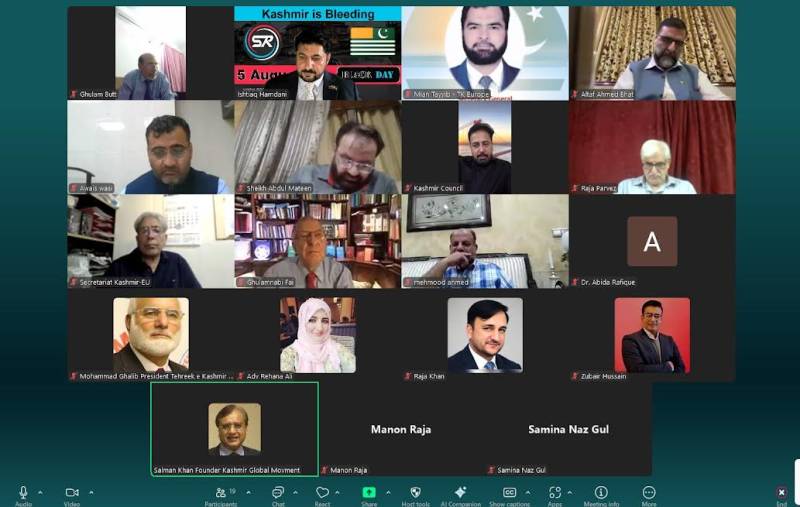
A well-organised webinar was held on the topic, “How the world can support Kashmir?” during which the speakers shared many practical suggestions. Ishtiyaq Hamdani, Chief Editor, Sada-e-Rus and Coordinator of Tehreek-e-Kashmir Russia Chapter, was the main host. Ishtiyaq Hamdani is a well-respected journalist in Moscow who has attended many press briefings with Russian Foreign Minister Sergei Lavrov, where he raised the issues concerned with Pakistan- Russia relations. Ishtiyaq Hamdani is equally engaged in raising awareness about Kashmir in the corridors of power, be it Moscow or else. Tehreek-e-Kashmir, Europe under the chairmanship of Mohammad Ghalib, has been able to establish more than 25 Chapters in Europe, including Russia, Norway, Spain, Italy, Germany, France, Sweden, Denmark, etc.
Mian Tayyib, General Secretary, Tehreek-e-Kashmir from Norway, opened the meeting by reciting a few verses from Al-Quran.
Mohmmad Ghalib, President of Tehreek-e-Kashmir Europe and veteran Kashmiri global diaspora leader, thanked the speakers for their willingness to participate in this timely webinar. He suggested that any Pakistani parliamentary delegation must include a experienced scholar or academic of Kashmiri heritage.
Ghulam Nabi Bhat, Chairman, Jammu Kashmir Community International (JKCI), said that his organisation has been deeply involved in raising awareness about human rights violations not only in Pakistan but also in other important capitals as well.
Dr. Ghulam Nabi Fai, Chairman, World Forum for Peace & Justice, said that after the Pahalgam massacre, India’s aim to use the label ‘terrorists’ was to divert the attention of the world powers from the ground realities in Indian Occupied Kashmir. If India were as certain of the legal strength of its claim as it professes to be, would it not agree to the whole question being mediated or facilitated by President Donal Trump who brokered the ceasefire between New Delhi and Islamabad and has shown his willingness to offer his offices of mediation to settle the Kashmir dispute once for all? The mediation by President Trump will last a few months, and it will vindicate India’s position and bring it a resounding victory. But India knows that an impartial mediation or facilitation would be fatal to its claim.
Dr. Fai warned that factionalism in the Kashmiri diaspora will bring lasting discredit to all involved. One must hope that better counsels will prevail and the leaders who have all borne great personal hardships in the struggle will overcome their differences and speedily close ranks. They owe it to themselves, and they owe it to a cause consecrated by the blood of tens of thousands of martyrs.
Mehmood Ahmed Saghar, Acting Chairman, Jammu Kashmir Democratic Freedom Party and senior political leader, pleaded that the Government of Pakistan needs to redouble its diplomatic efforts to garner the support of other peace-loving countries on Kashmir. Mehmood Sagher added that the Kashmiri diaspora needs to mobilise global public opinion so as to persuade the Government of India to release all political prisoners, including Shabir Ahmed Shah, Mohammad Yasin Malik, Masart Aaalm, Aasia Andrabi and others.
Salman Khan, Founding President of South Africa Kashmir Action Group, said that the Kashmiri diaspora should learn from the strategy that was evolved by the South African diaspora under the leadership of Nelson Mandela. He called for the global unification of the Kashmiri diaspora. United we stand and divided we fall, warned Salman Khan, quoting the famous proverb.
Advocate Rehani Ali, educator and Information Secretary of Tehreek-e-Kashmir, said India calls itself the world’s largest democracy, but in Indian-occupied Kashmir, it rules with fear and force. The region is controlled by harsh, unjust and draconian laws, such as UAPA (Unlawful Activities Prevention Act), which criminalises peaceful speech and resistance of the youth, human rights activists, Kashmiri leaders and Journalists
Dr. Abida Rafique, Chairperson, Asian Resource Forum Kashmir, in her well-thought-out speech, explained the strategy to highlight the human rights dimension of the Kashmir issue. Kashmir is not a territorial dispute between India and Pakistan, she stressed.
Ali Raza Syed, Chairman, Kashmir Council, EU, said that the European Parliament is a very important global forum. If we want to have tangible progress on the Kashmir issue, let the Kashmiri delegations knock on the doors of important capitals of the world, including Brussels.
Altaf Ahmed Bhat, a prominent Hurriyat leader, said that freedom of speech in Kashmir is under threat. Human rights activists, journalists and even common people’s dissenting voices are facing legal consequences.
Dr. Awais Bin Wasi, a well-known Academic and analyst, suggested compiling all the recommendations which speakers put forth during the webinar and sending them to the concerned quarters for action.
Ms. Manan Raja of France, a travel blogger, narrated her experiences while meeting with people of other nationalities and different backgrounds. She said we need to continue to raise awareness about Kashmir at all forums. If Scotland can have a referendum, why not Kashmir? Manan Raja asked.
Sheikh Abdul Mateen, a well-known Hurriyat leader and human rights advocate, suggested contacting academic institutions and think tanks to organise seminars, conferences and symposia on Kashmir.
Others who spoke included: Sardar Taimor of Azad Kashmir; Zubair Hussain. Political and Social Personality of Sweden, Ms. Samina Naz Gul, Chief Organiser, JKCI, Raja Parvaiz, General Secretary, JKCI, Raja Khan, and others.