
SC urged to form 16-member bench to hear pleas against 26th Amendment
Hamid Khan says 26th Amendment adversely affected independence of judiciary: Says formation of full bench necessary to hear constitutional matters: Hearing adjourned until tomorrow
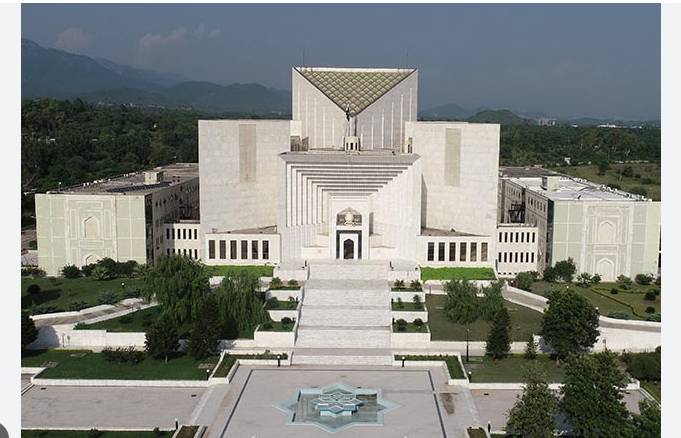

An eight-member constitutional bench (CB) of the Supreme Court (SC), headed by Justice Aminuddin Khan, resumed the hearing on Wednesday of 36 petitions filed against the 26th constitutional amendment, reported 24NewsHD TV channel.
Other judges on the bench are Justice Jamal Khan Mandokhel, Justice Muhammad Ali Mazhar, Justice Ayesha Malik, Justice Hassan Azhar Rizvi, Justice Musarrat Hilali, Justice Naeem Akhtar Afghan and Justice Shahid Bilal Hassan.
Today, arguments will be given for and against constituting a full court in the case.
On Tuesday, the bench had allowed the livestreaming of the case proceedings.
The 26th Amendment, which was passed by both Houses of the parliament in October last year, took away the apex court’s suo motu powers, set the chief justice of Pakistan’s (CJP) term at three years and empowered the prime minister to appoint the next CJP from among the three most senior Supreme Court judges.
The amendment also paved the way for the formation of the constitutional bench, which is now hearing petitions filed by various high court bar associations, PTI and others against the very legislation that led to its establishment.
During the Wednesday’s proceedings, Hamid Khan, the counsel for the Lahore High Court Bar Association (LHCBA), told the eight-member constitutional bench (CB) of the Supreme Court (SC), hearing the petitions against the 26th constitutional amendment, that the Bar wanted the formation of a full-court for the hearing of these petitions.
He said that the Bar wanted a 16-member bench to hear these petitions. “All judges, who are presently on this bench, were also included in the 16-member bench, which was at the time of the passage of the 26th Amendment,” the lawyer said, adding, “We want the inclusion of the remaining eight judges in the bench.”
Hamid recalled that there were 17 judges present in the SC at the time the legislation was passed, including then-CJP Qazi Faez Isa, who later retired. Therefore, he contended, a 16-judge “full court” bench as of then should hear the pleas and pointed out that all eight judges in the current CB would be part of that bench as they were already serving as SC judges in October last year.
Justice Aminuddin Khan, the head of the bench, asked Hamid where in the constitution it was written that it was mandatory to form a 16-member bench.
Justice Jamal Khan Mandokhel asked whether the 26th Amendment was presently part of the constitution.
Justice Mandokhel also asked what the judicial commission had to do with the formation of benches.
Justice Hilali also observed that whether the 26th Amendment was “right or wrong”, the court had not suspended it yet. “You consider the 26th Amendment a part of the Constitution, which is why you have challenged it.”
Here, Justice Mazhar noted that the constitutional bench was at the moment not considering the main case but the request for a full court and sought arguments on that.
Hamid responded that he was not detailing how the 26th Amendment was unconstitutional but on the “effects of its powers”. He said it was for the first time after the legislation that the “authority to form benches was taken away from the chief justice”.
Noting that the Judicial Commission of Pakistan existed prior to last year’s constitutional tweaks, the LHCBA counsel said the 26th Amendment impacted the JCP’s formation as “judges became a minority” after the number of its members was increased.
“After the Amendment, the majority in the Judicial Commission went to the administrative side, which affected judicial independence,” Hamid said.
Upon Justice Mandokhail asking Hamid whether he was acknowledging the 26th Amendment or not, the lawyer replied in the negative.
Hamid further said that if a full court would declare the amendment null and void, it would be deemed that it did not exist from the very first day.
Justice Amin asked whether the amendment would be deemed to be part of the constitution until and unless it was annulled. “For the time being, you will give arguments, bearing in mind that the amendment is part of the constitution,” he told Hamid.
Justice Jamal Mandokhel reminded the LHCBA lawyer that he was giving arguments before the bench, which was the direct result of the amendment.
Justice Musarrat Hilali also conveyed to Hamid that the amendment had not been suspended as yet.
The lawyer said that it was for the first time after the amendment that the power to form benches had been snatched from the Chief Justice of Pakistan.
Justice Amin remarked that two benches had been formed following the passage of the 26th Amendment. “A constitutional bench has been formed to hear the cases related to the constitution.”
The lawyer said that even prior to the passage of the 26th Amendment, there existed a judicial commission. “However, the 26th Amendment has affected the constitution of the commission since the judges are now in a minority in the commission.”
Hamid argued that the amendment had also affected the independence of the judiciary because the judges were not in a majority.
On this occasion, Justice Muhammad Ali Mazhar remarked that now the members of the parliamentary committee had been included in the commission.
The lawyer asserted that what needed to be protected was the independence of the judiciary.
At that moment, Justice Mandhokhel asked Hamid whether he acknowledged that the amendment existed. “No, we do not recognize it,” the latter replied.
Justice Ayesha Malik said she wanted to know where in the 26th Amendment, there was a bar on the formation of a full court.
Hamid replied that there was no restriction on the formation of a full court in the 26th Amendment.
Justice Amin, however, said he was at a loss to understand under what law a full court should be formed.
Justice Ayesha, however, was of the view that the constitution of a full court through a judicial order was not prohibited. “Where in the 26th Amendment it is written that there cannot be a judicial order,” the judge asked, adding when it happened in ordinary cases, why not in this case.
Justice Afghan reminded Hamid that he had not sought the formation of a full court in his plea.
Addressing the LHCBA lawyer, Justice Mazhar asked him to guide as to how the bench could order the formation of a full court. “Should Article 187 be invoked for the purpose?” he questioned.
Hamid replied, “Yes the article can be invoked.”
He went on to say that the bench had to determine whether the amendment was in line with the constitution. “Whenever, there was any constitutional question, a full court was formed to answer it,” he argued.
Hamid completed his arguments in the case.
Following that, the hearing was adjourned until tomorrow.
Reporter: Amanat Gishkori