
Bangladesh women march to demand representation in polls
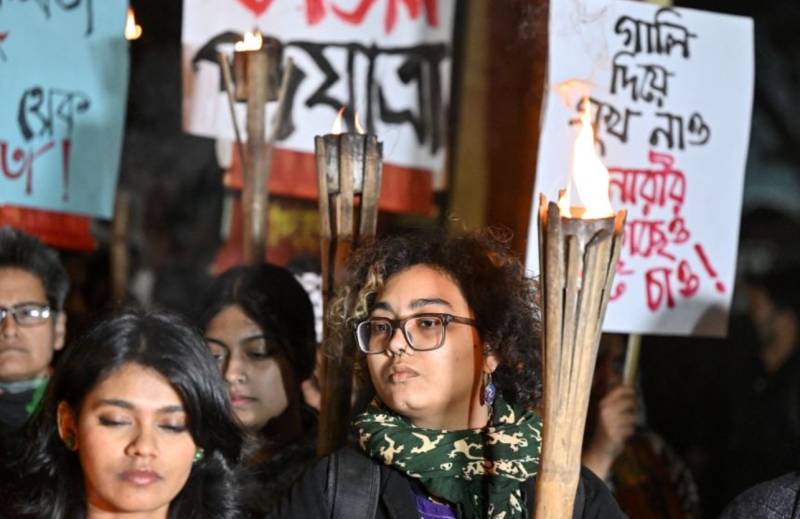

Bangladeshi women carried flaming torches through the streets of Dhaka on Monday, marching to demand justice and political representation in the coming elections.
Despite helping spearhead the 2024 uprising that paved the way for the vote on Thursday, women are poised to be largely excluded from the South Asian country's political arena.
Women candidates make up fewer than four percent of the election hopefuls, while 30 of the parties contesting this week's race put forward male-only tickets.
"Whatever regime is in place, repression of women appears in many different forms," said protester Priya Ahsan Chowdhury, 31, a Supreme Court lawyer, who joined around 100 women chanting slogans and singing in front of parliament.
"In some places, we haven't seen any representation of women at all — only men. That is what drove us to come out and speak up."
The march, which began at midnight Sunday and ended in the early hours of Monday, came against a backdrop of rising incendiary rhetoric targeting women at religious and political rallies, and growing attempts to push them out of public life.
The February 12 vote will be the first election since the overthrow of the autocratic government of Sheikh Hasina.
"The aspiration of the mass uprising was to build a country based on justice and equality -- but women are slowly being erased from the public sphere," said protester Sabhanaz Rashid Diya, 38, head of the Tech Global Institute think tank.
"And now, when we are once again dreaming of building a new country, political parties where women once played key roles have largely sidelined them in the electoral race."
Bangladesh has long been led by powerful women, including Hasina and her longtime rival, the late three-time prime minister Khaleda Zia.
Bangladesh's largest Islamist political party, Jamaat-e-Islami, has not fielded any women candidates, while its members have suggested that society is not ready for women in politics.
Rivals rally on final day
Bangladesh's election campaign entered its final day Monday ahead of the February 12 vote, as rival parties invoked the 2024 uprising that ended the autocratic rule of Sheikh Hasina.
Tens of thousands of flag waving supporters have attended weeks of rival rallies across the sprawling capital Dhaka, as parties each seek to harness the legacy of the mass uprising -- and pitch competing visions of change for the country of 170 million.
The South Asian nation will elect a new parliament, with the Bangladesh Nationalist Party (BNP) -- led by Tarique Rahman, who returned in December after 17 years in exile -- widely tipped as a frontrunner.
The BNP's Rahman led a rally on Sunday in Dhaka's Mirpur neighbourhood -- constituency of Shafiqur Rahman, the leader of his main rival, Jamaat-e-Islami.
"I can talk about him forever, but that won't benefit the people of Bangladesh," the BNP leader said about the Islamist chief, to crowds waving flags with the party symbol, a sheaf of rice.
A heavy deployment of armed police monitored the rally, with drones hovering above, as he backed the local BNP candidate Shafiqul Islam Milton.
"Help him win the election, and he will take care of you once elected," Rahman told the BNP crowds.
Rahman, 60, better known in Bangladesh as Tarique Zia, assumed leadership of the BNP following the death of his mother, former prime minister Khaleda Zia, who died in December at the age of 80.
Hasina's Awami League was banned by the interim government from running in the elections, a move criticised by rights groups.
'Long live the revolution'
Jamaat-e-Islami chief Shafiqur Rahman meanwhile addressed a packed rally in the Dhaka-11 constituency, a flashpoint during the August 5, 2024 uprising that toppled the Awami League government of Hasina after 15 years in power.
Shafiqur Rahman, leading a coalition of Islamist parties -- under the symbol of weighing scales -- accused the former ruling party of widespread repression, but warned that new forms of abuse had quickly followed its fall.
"A section of the oppressed turned into oppressors just a day after August 5," he said, alleging extortion and corruption by returning political figures.
"Common people, business owners — even beggars — are now fed up. Justice has been sent into exile."
Jamaat, ideologically aligned with the Muslim Brotherhood and seeking a return to formal politics after years of bans and crackdowns, has allied with the National Citizen Party (NCP), formed by student leaders who spearheaded the uprising.
NCP leader Nahid Islam accused major parties of quietly sharing the "businesses of extortion and crime" for decades.
"If you elect me, I will dedicate myself to the betterment of the area," Islam vowed, especially thanking women supporters and warning: "If we lose, August 5 will also lose."
Supporters chanted popular slogans from the uprising.
"Long live the revolution!" supporters shouted.
"Slavery or freedom?", they chanted, replying in unison, "Freedom, freedom!"
Among them was Mohammed Harun, 65, who said he had not voted in 17 years but would back the Jamaat-led alliance in hopes of a "just, corruption and violence-free country".
Fatema Begum, a 40-year-old housewife, said she wanted a Bangladesh where people could "live independently and speak freely".
First-time voter Abdullah-al-Rahat, 21, a Dhaka University student who took part in the 2024 uprising, said Jamaat leaders appeared "honest and humble", but favoured a unity government if no party won a majority.
Hasina, 78, sentenced to death in absentia in November for crimes against humanity for the deadly crackdown on protesters in her failed bid to cling to power, remains in hiding in India.