
27th Constitutional Amendment Bill tabled in National Assembly
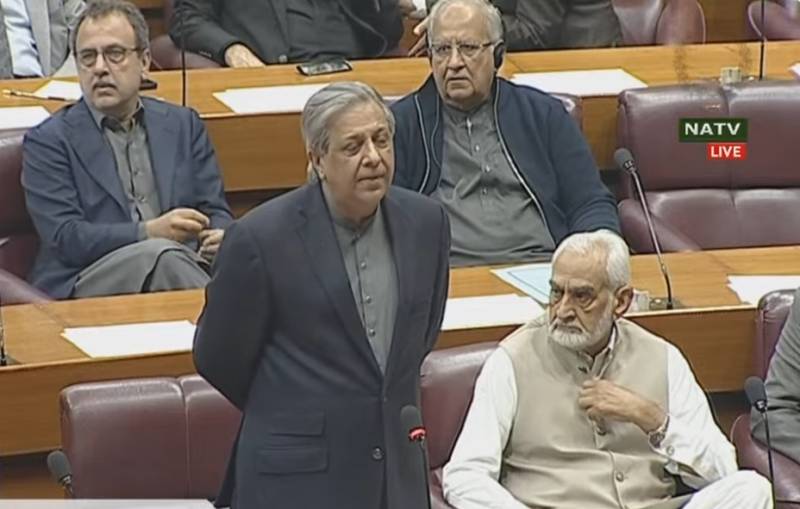

After the dramatic passage of 27th Constitutional Amendment Bill in the Senate, the government tabled the legislation in the Lower House of the Parliament – National Assembly – on Tuesday, hoping for smooth passage, reported 24NewsHD TV channel.
Federal Law Minister Azam Nazeer Tarar introduced the bill in the House, defending the plethora of amendments.
The National Assembly session began with lawmakers offering fateha for PML-N Senator Irfan Siddiqui, who breathed his last on Monday night.
Speaker Ayaz Sadiq later asked Law Minister Tarar to move the bill for the constitutional amendment to be taken into consideration.
Tarar introduced the bill, recalling that when the legislation for the 26th Constitutional Amendment had landed in the house, “two main political parties, after much debate and discussion, made a few adjustments in the promises made to the public under the Charter of Democracy”.
“One of those key points was the establishment of a constitutional court,” Tarar continued.
Subsequently, he said, the amendment for establishing a constitutional bench was passed. However, he added, several objections were raised over it, with the critics saying that “you have formed a court within a court, and that this system will not continue”.
Govt enjoys support of 237 MNAs
The bill needs a two-thirds majority in order to be passed by the National Assembly.
The ruling coalition might not have to toil hard for the passage of the 27th Amendment by the National Assembly (NA) as in the House of 336 members, it enjoys the support of 237 members, while the support of 224 MNAs is required for the passage of the amendment.
There are 126 MNAs of the PML-N, 75 of the PPP, 22 of the MQM-P, five of the PML-Q, four of the Istehkam-e-Pakistan Party (IPP), while one each of the BNP and Zia League.
The ruling alliance also enjoys the support of four independents.
On the other hand, the total strength of the opposition in the Lower House stands at 90.
In the opposition, there are 74 independents, one belongs to the Sunni Ittehad Council (SIC), 10 to the JUI-F, while the National Party (NP), Balochistan National Party (BNP), Majlis Wahdat-e-Muslimeen (MWM) and the Pashtunkhwa Milli Awami Party (PMAP) have one MNA each in the House.
https://www.youtube.com/watch?v=LAjv973y0Ag
Constitutional courts are worldwide
Addressing the National Assembly session, Azam Nazeer Tarar said around the world constitutional courts hear constitutional cases, and judges are appointed through judicial commissions. He explained that much of the judiciary’s time is consumed by constitutional matters, and with the establishment of a constitutional court, other cases will be resolved more swiftly.
--Opposition parties' role--
Tarar added that during the passage of the 26th Amendment, benches were formed instead of a constitutional court at the suggestion of Maulana Fazlur Rehman. He said the government had hoped that the opposition would share its proposals on this important issue, but opposition parties did not present their amendments during the joint parliamentary session. However, he noted that a broad consensus was achieved on the 27th Constitutional Amendment.
--Individual suo motu powers ended--
The federal law minister remarked that in the past, suo motu powers were used excessively, at times against a sitting prime minister or senior government officials. Former Prime Minister Yousaf Raza Gilani, he recalled, was also removed through a suo motu notice. Tarar emphasised that now, such suo motu notices will not be taken at the will of any single individual.
--Senior-most judge to assume CJP position--
He further stated that the Chief Justice of Pakistan, Yahya Afridi, will head the Supreme Judicial Council and the Law and Justice Commission, and that in the future, only the senior-most judge will assume the position of Chief Justice.
--Appointment of COAS--
Azam Nazeer Tarar said the appointment of the Army Chief is carried out under the Army Act, and the Prime Minister grants approval for the appointment according to the established procedure.
The law minister said that Pakistan had achieved a historic victory in Operation Bunyan un Marsoos and that the entire nation stood united with the Pakistan Armed Forces against Indian aggression.
He praised the outstanding services of the Chief of Army Staff, General Asim Munir, for the defence of the country and said that, in recognition of his contributions, the government had conferred upon him the title of Field Marshal.
‘Mourning Day for democracy’
Stating categorically that the PTI did not accept the 27th Constitutional Amendment, PTI Chairman Barrister Gohar said on Tuesday that presenting oneself for accountability was the supremacy of the law.
Speaking in the National Assembly, he said that it would be better to call this amendment, ‘Baku Amendment’ because the prime minister of a nuclear state was taking part in deliberations on the amendment while he was sitting in Baku.
He further said that the government by setting up a constitutional court wanted to get verdicts of its choice. “For democracy, changes in the constitution are made after developing a consensus,” he said, adding, “Unfortunately, no effort was made to reach consensus on the amendment.”
He lamented that the chief justice of Pakistan was no longer the chief justice of Pakistan because he had been robbed of his powers.
Gohar said that the PTI was contemplating challenging the legislation in court.
“Today is a sad day for democracy,” PTI chairman said, adding, “Nowhere in the world, a president is granted immunity from criminal cases.”
JUI-F chief Maulana Fazlur Rehman has directed party lawmakers to oppose the 27the Amendment Bill and vote against it in the National Assembly.
In a letter written to JUI-F MNAs, Fazl said they discussed it in detail in the JUI parliamentary party meeting and they decided to oppose this amendment.
The passage of the bill in the Upper House of the Parliament on Monday saw two members of the Opposition parties – one each from PTI and JUI-F – voted for the amendment.
The government and its coalition partners secured a two-thirds majority in the Senate vote for the bill following the defection of two opposition members.
The bill, which had stirred a bitter controversy across the country for weeks, was presented in the Senate by Law Minister Azam Nazeer Tarar, while Senate Chairman Syed Yousaf Raza Gilani presided over the proceedings.
Before the passage of the bill, the opposition benches erupted in protest, chanting slogans against the government and its coalition partners. Lawmakers tore up copies of the bill and hurled them toward Nazeer Tarar’s table as he began to present it.
Most opposition members then staged a walkout, while a few stayed back to continue sloganeering before exiting the chamber — paving the way for the smooth passage of the bill.
A joint meeting of the Senate and the National Assembly’s law and justice standing committees — boycotted by the opposition — approved the 27th Constitutional Amendment bill with minor changes. Senate Standing Committee of Law and Justice Chairman Farooq H Naek presented a report on those before the Upper House.
The bill aims to set up a federal constitutional court and grant lifetime status to the field marshal rank.
On Sunday, a joint meeting of the Senate and the National Assembly’s law and justice standing committees had approved the 27th Constitutional Amendment bill with minor changes amid a boycott by the opposition.
Bill sails through Senate
One of the central provisions includes amendments to Article 42, paving the way for the establishment of a Federal Constitutional Court. A recount requested by the opposition confirmed the approval of the clause by majority vote.
Amendments to Articles 59, 63A, 68, 78, and 81 were also passed, formally replacing references to the Supreme Court with the Federal Constitutional Court wherever specified.
The Senate approved an amendment to Article 93, granting the Prime Minister the authority to appoint up to seven advisors.
An amendment to Article 100 replaced references to the Supreme Court with the Federal Constitutional Court, a theme echoed in multiple subsequent clauses.
Changes to Articles 114, 130, 165A, 175, and 175A were also approved, many of which embed the Federal Constitutional Court into the judicial and constitutional framework and alter the composition and functions of the Judicial Commission responsible for appointing judges.
Several of the most significant amendments relate directly to the restructuring of Pakistan’s judicial hierarchy:
Under the revised Article 175A, the Judicial Commission will now include the Chief Justice of the Federal Constitutional Court, the Chief Justice of the Supreme Court, and one senior judge each from both courts.
The amendment also adds one senior judge from the Supreme Court and one from the Federal Constitutional Court to the Judicial Commission.
Amendments to Article 175D require judges of the new Constitutional Court to retake their oaths under the Third Schedule of the Constitution.
The new structure places the Federal Constitutional Court above the Supreme Court for constitutional matters. According to the approved clause:
Decisions of the Federal Constitutional Court will be binding on all courts, including the Supreme Court.
Supreme Court decisions will not apply to the Constitutional Court.
All constitutional public-interest cases currently in the Supreme Court will be transferred to the Constitutional Court.
An amendment was also approved enabling judges with at least five years of High Court service to become judges of the Federal Constitutional Court.
One of the most consequential amendments is the abolition of the Supreme Court’s suo motu powers. The Senate approved:
The transfer of suo motu authority to the Federal Constitutional Court. The deletion of Article 184 from the Constitution. The deletion of Articles 186 and 191A.
Amendments to Article 200 were also passed to limit the President’s authority in transferring judges.
The President may now transfer any High Court judge only on the recommendation of the Judicial Commission.
A clause further restricts judicial transfers by ensuring:
No High Court Chief Justice may be transferred.
No judge senior to a Chief Justice will be transferred in a way that disrupts seniority.
A transferred judge will not outrank the Chief Justice of another court.
Refusal to accept a transfer will result in a reference being filed before the Supreme Judicial Council. Judges who refuse appointment to the new Federal Constitutional Court will also face a reference.
Amendments also grant pensions and benefits to judges for a fixed period upon retirement.
Changes to Article 209 require the formulation of new rules for the Supreme Judicial Council within 60 days. The Council will now include:
The Chief Justice of the Supreme Court
The Chief Justice of the Federal Constitutional Court
Two senior judges each from both courts
Two senior High Court judges
Additional provisions allow joint nominations for judges serving two-year terms on the Council.
One of the most debated changes came through amendments to Article 243. Seven new clauses were added, including provisions to:
Change the title of the Chief of Army Staff to Commander of Defence Forces.
Abolish the office of the Chairman Joint Chiefs of Staff Committee effective November 27, 2025.
Empower the Prime Minister, on the President’s advice, to appoint the Commander of Defence Forces.
Establish the position of Commander of National Strategic Command, to be appointed on the recommendation of the Army Chief.
Another clause grants the federal government authority to promote military officers to the rank of Field Marshal, Air Marshal, or Admiral Chief, with lifetime uniforms and privileges. These positions will be considered “heroes” and may not be removed except under Article 47.
The federal government will define the responsibilities of these top-ranking officers, while the Field Marshal will receive legal immunity under Article 248.
The Senate also approved an amendment to Article 248, granting the President lifetime immunity from legal action after leaving office — unless he or she accepts another public office, upon which the immunity will lapse.
Amendments to the Third Schedule were approved to incorporate the title “Chief Justice, Federal Constitutional Court” into the oath prescribed for judicial officeholders.
Before the final stage of voting, bells were rung for two minutes to alert members to return to the chamber. The doors were then sealed, and the Senate proceeded to vote on the complete 27th Constitutional Amendment Bill.
Reporters Hashir Ahsan Warraich, Usman Khan