
KP AG challenges IHC jurisdiction over PTI Sept 27 long march
KP advocate general argues IHC cannot direct officials in other provinces: PTI separately seeks court protection against police raids and arrests in Punjab before its long march: CJ Dogar questions whether KP CM's political role conflicts with his state oath: Adv Gen raises concerns over placing containers, court orders and citizens' right to protest.
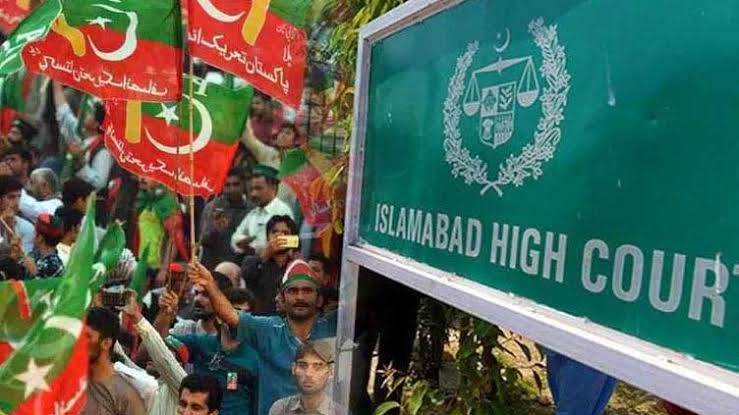

Khyber Pakhtunkhwa's (KP) Advocate General (Adv Gen) Shah Faisal has challenged the jurisdiction of the Islamabad High Court (IHC) to hear a petition against Pakistan Tehreek-e-Insaf's (PTI) planned September 27 protest and long march on Friday.
A three-member larger bench, headed by Chief Justice Sarfraz Dogar and comprising Justice Muhammad Azam Khan and Justice Muhammad Asif, heard the petition. Advocate General Khyber Pakhtunkhwa Shah Faisal began his arguments before the court.
According to the 24NewsHD TV channel, Shah Faisal argued that the Islamabad High Court's jurisdiction was limited to the federal capital and that it could not issue directions to officials in the Sindh, Khyber Pakhtunkhwa, Punjab or Balochistan provinces.
He said that if one high court interfered in matters falling within the jurisdiction of other provinces, the 18th Amendment would effectively become meaningless.
The advocate general also argued that Islamabad was not a province but a territory, which was why separate legislation had been enacted for it. He further claimed that the petitioner was not an affected party in the matter.
He said that after the end of the suo motu process, a similar practice had begun through public interest petitions. If the Islamabad High Court entertained the petition, he argued, it would undermine the intention of the legislature.
During the hearing, Chief Justice Sarfraz Dogar asked the law officer whether the party was actually planning a long march. The advocate general replied that the party against which the petition had been filed had not even been made a party to the case.
The chief justice then asked whether Shah Faisal had consulted the Khyber Pakhtunkhwa chief minister about the case. He said the chief minister should be more loyal to the state than to a political party.
The chief justice observed that the chief minister was, on one hand, the head of the provincial government and, on the other, a member of a political party. Shah Faisal responded by saying that if the chief minister were not a party member, he would not have become chief minister.
The advocate general later asked the court to forgive him if he made a mistake during his arguments. Chief Justice Dogar replied that he did not forgive mistakes but would explain them to him.
At another point, the advocate general remarked that the chief justice was the "king" who could do whatever he wanted. The chief justice responded that there was no need to say it, stressing that it was a court and that the judiciary carried out its responsibilities.
The petitioner's lawyer also reacted to the exchange, saying he had never heard a chief law officer describe a chief justice.
Separately, the PTI has filed a constitutional petition before the Rawalpindi bench of the Lahore High Court against police actions ahead of its September 27 Long March.
The petition was filed by PTI Rawalpindi General Secretary Aqeel Khan, naming the Punjab government, the Punjab inspector general of police, the regional police officer and the Rawalpindi city police officer as respondents.
The petition said that police have been conducting raids on the homes of PTI workers and leaders in the Rawalpindi division and Mianwali. It claims that party workers are being harassed without legal justification.
According to the petition, the police action is intended to prevent PTI workers from taking part in the September 27 march. It argues that raids on private homes violate Article 14 of the Constitution.
The petition asks the court to stop raids, arrests and harassment of PTI workers on the basis of their political affiliation and to seek a verified report from police authorities concerning the arrests. The petitioner has also requested immediate interim relief before September 27.
Chief Justice Dogar asked the advocate general whether he had consulted the KP chief minister, Sohail Afridi, about the case. Shah Faisal replied that the long march was not being organised by the chief minister.
The chief justice then asked whether the advocate general agreed with any statement made by the chief minister. Shah Faisal said the chief minister was also a member of a political party.
"Do you mean he is wearing two hats?" the chief justice asked. Shah Faisal said the chief minister was both the head of the provincial government and a member of a political party. The chief justice asked how he could have become chief minister if he had not been a member of the party.
At the court's direction, Shah Faisal read out the oath taken by the CM. Chief Justice Dogar said the chief minister should be more loyal to the state. The advocate general replied that the chief minister was highly loyal to the state and had made no statement against the Constitution, the law or the state.
The chief justice then summoned the KP chief secretary to the rostrum and said the advocate general was unable to answer the court's question about why the chief minister had made the statement in question.
He stressed that his question concerned the chief minister rather than the political party, saying that a person holding the office of chief minister had taken an oath to remain loyal to the state.
The chief secretary replied that the chief minister himself could respond to questions concerning his statement about the political gathering.
The chief justice also questioned why such protests always came towards Islamabad. The chief secretary described it as political activity.
"Is an attack on the federal capital political activity?" the chief justice asked. The court subsequently sought sworn statements from the Khyber Pakhtunkhwa chief secretary and inspector general of police.
The advocate general argued that protests were organised by political parties, not governments. He also referred to statements by the Punjab CM Maryam Nawaz, who he said had claimed that the threat came from KP rather than India and that terrorism was being carried out from the province into Punjab.
Shah Faisal questioned whether such remarks amounted to an attempt to undermine his province. He also referred to a statement by Rana Sanaullah, saying the latter had claimed that the high court would issue a decision against the long march.
Justice Muhammad Azam Khan told the advocate general that it appeared he was making political arguments. Shah Faisal replied that he was presenting facts rather than making political statements.
The advocate general said the case appeared to him to be more political than legal. Chief Justice Dogar said those seeking to strengthen the judiciary had also been violating its orders.
Shah Faisal replied that there had also been a struggle for the rule of law and the judiciary in 2007. The chief justice said that chapter had ended and that the judiciary of that period had also gone.
Chief Justice Dogar said protests did not have to be held only in Islamabad and could take place elsewhere. Shah Faisal replied that such a decision would be a matter of policy.
The chief justice said the court would intervene if the rights of Islamabad's residents were affected.
The advocate general responded that Islamabad belonged as much to people from KP, Balochistan, Punjab and Sindh as it did to its own residents. He said an impression should not be created that other citizens were being excluded from the federal capital.
KP law officer also raised question about failure of implementation of court orders from Adiala Jail authorities regarding Imran Khan.
Chief Justice Dogar said the matter of contempt concerned the person alleged to have committed contempt and the court. Shah Faisal argued that the issue was also affecting the listing of cases.
The chief justice replied that the listing of cases was an administrative matter for the court and that the court itself decided when cases would be heard.
He asked whether the advocate general was suggesting that cases should be listed according to his wishes. Shah Faisal denied making such a claim and said he was speaking about the rights of the public.
The chief justice responded that the argument amounted to a direct attack on the judiciary.
The advocate general then raised the issue of security arrangements during political protests. He said containers were placed in Islamabad even before citizens arrived whenever a long march was announced.
He questioned whether placing containers amounted to a violation of citizens' rights and urged the court to take notice. He said he had video evidence showing containers being placed outside the Khyber Pakhtunkhwa House.
Shah Faisal concluded his arguments by saying that public confidence was declining.
Reporters: Ehtisham Kiyani, Babar Shehzad Turk, and Ershad Qureshi