
'Space for Sustainable Development': Three-day international conference to begin in Islamabad tomorrow
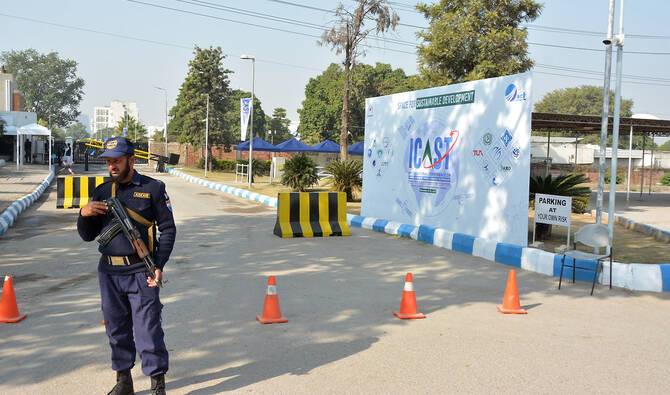

Pakistan is set to host a three-day international space conference beginning tomorrow (Tuesday), with delegates from more than 25 countries across Asia, Europe, Africa, North America, and Oceania.
The International Conference on Applications of Space Science and Technology (ICAST-2025) will take place in Islamabad from Nov. 18–20. Jointly organized by the Pakistan Space and Upper Atmosphere Research Commission (SUPARCO) and the Institute of Space Technology (IST), this year’s event focuses on the theme “Space for Sustainable Development.”
The conference will highlight the expanding role of space-based technologies in addressing global challenges. “ICAST-2025 is expected to be one of the region’s largest space-related gatherings, with more than 2,000 participants, including over 70 international delegates from 25 countries,” according to a report.
Senior officials from global space agencies, scientists, researchers, astronauts, policymakers, and industry experts are expected to attend. The program includes panel discussions, seminars, plenary sessions, masterclasses, and technical sessions covering emerging trends in satellite technology, climate monitoring, geospatial intelligence, and AI-driven applications.
A dedicated Technology Exhibition and a technical poster showcase will feature cutting-edge innovations and research from around the world.
The event will also host a “Meet the Astronauts Forum,” bringing together astronauts from Türkiye, Mongolia, and the United States to interact with students, share their spaceflight experiences, and inspire young people to pursue careers in space science.
Pakistan is also expected to sign several memorandums of understanding with institutions from Kazakhstan, Tunisia, Senegal, Bangladesh, and Iraq to strengthen international cooperation. These agreements aim to boost joint research, capacity building, and knowledge sharing in space science and technology.
The initiative reflects Pakistan’s growing investment in its space program. Last month, the country launched its first Hyperspectral Satellite (HS-1) from China’s Jiuquan Satellite Launch Center. HS-1 now joins Pakistan’s expanding remote-sensing constellation, which includes the PRSS-1 satellite launched in 2018 and the EO-1 and KS-1 Earth-observation satellites placed in orbit earlier this year.
China also announced that a Pakistani astronaut will train aboard the Chinese space station and participate in upcoming short-duration spaceflight missions as a payload specialist.