
Saudi Crown Prince tells British PM attacks on Gaza 'heinous'
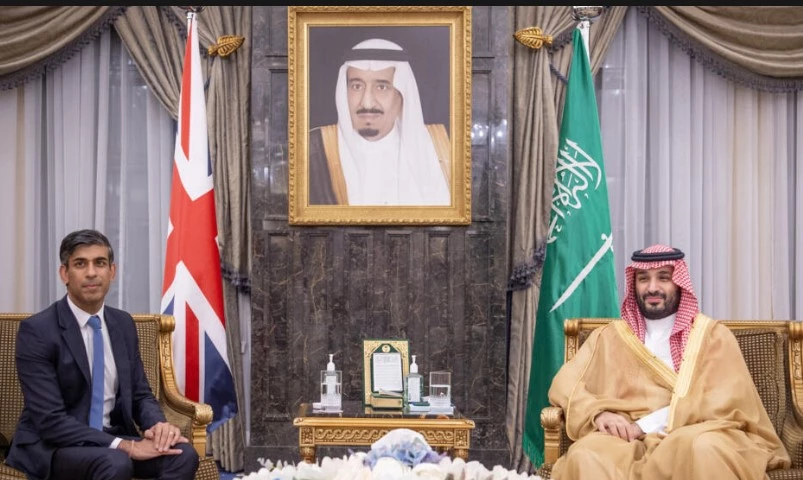

Saudi Arabia's crown prince said on Thursday that attacks on civilians in Gaza were "heinous" and warned of "dangerous repercussions" should the war between Israel and Hamas expand, state media reported.
Mohammed bin Salman, the Gulf kingdom's de facto ruler, made his comments during a meeting with British Prime Minister Rishi Sunak, who before visiting Riyadh met with Israeli leaders and pressed them to let more humanitarian aid into Gaza.
Prince Mohammed "affirmed that the kingdom considers targeting civilians in Gaza a heinous crime and a brutal attack, stressing the necessity of working to provide protection for them," the official Saudi Press Agency reported.
He also "stressed the need to make all possible efforts to reduce the pace of escalation and ensure that the violence does not expand in order to avoid its dangerous repercussions on security and peace in the region and the world."
Hamas militants stormed into Israel from the Gaza Strip on October 7 and killed at least 1,400 people, mostly civilians who were shot, mutilated or burnt to death, according to Israeli officials.
Israel says around 1,500 Hamas fighters were killed in clashes before its troops regained control.
More than 3,700 Palestinians, mainly civilians, have been killed across the Gaza Strip in retaliatory Israeli bombardments, according to figures from its Hamas-run health ministry.
Sunak and Prince Mohammed "agreed that the loss of innocent lives in Israel and Gaza over the last two weeks has been horrific," according to a readout from Sunak's office.
They also "agreed on the pressing need for humanitarian access into Gaza to provide vital water, food and medicine," it said.
Sunak "encouraged the crown prince to use Saudi's leadership in the region to support stability, both now and in the long term," it added.
Prince Mohammed also spoke by telephone on Thursday with UN Secretary-General Antonio Guterres, SPA reported.
In that conversation he advocated for "strengthening international and regional efforts to stop military operations" and urged the UN to provide "safe humanitarian corridors" to get food and medical care into Gaza.
Since the war broke out, Saudi Arabia has issued a series of statements denouncing the displacement of Palestinians from their homes and attacks on "defenceless civilians" while affirming its support for the Palestinian cause.
The violence has dealt a blow to efforts by US President Joe Biden's administration to broker a deal that would see Saudi Arabia, guardian of Islam's holiest sites, recognise Israel.
Last week, a source familiar with that process told AFP that Riyadh had decided to "pause discussion on possible normalisation".
Israel killed member of 'journalist team'
Lebanon's army blamed Israel Friday for killing a member of a "journalist team" covering cross-border tensions in the country's south, as war rages further south between Israel and Gaza-based militants.
On Thursday, "a journalist team of seven people covering news... near the Israeli enemy’s al-Abad site outside the town of Hula, was targeted with machine guns by enemy (Israeli) members, killing one and injuring another," the Lebanese army said in a statement.
Earlier, peacekeepers with the UN Interim Force in Lebanon (UNIFIL) said in a statement that one person had been killed after civilians were caught in cross-border fire in Lebanon's south.
Lebanese armed forces asked them for help "for seven individuals stranded near" the border during "a significant exchange of fire", UNIFIL, said in its statement. A spokesperson confirmed they were all civilians.
"Tragically, one person lost his life during this incident and the others were successfully rescued," UNIFIL said. They asked the Israeli forces to suspend fire "to facilitate the rescue operation" and they complied, the statement added.
UNIFIL force acts as a buffer between Lebanese and Israeli troops.
Lebanon's Iran-backed Hezbollah and allied Palestinian factions have been trading cross-border fire with Israel daily since Hamas launched its massive October 7 assault in southern Israel, killing at least 1,400 people, most of them civilians.
More than 3,700 Palestinians, mainly civilians, have been killed across the Gaza Strip in retaliatory Israeli bombardments, according to figures from its Hamas-run health ministry.
The latest border incident brings to at least 22 the number of people killed in south Lebanon since the Israel-Hamas war began.
Most of them have been combatants, but at least four civilians, including a Reuters journalist, have been killed. At least three people have been killed in Israel.
- 'Trapped by gunfire' -
Earlier, local Lebanese media had reported that the group included Iranian journalists, although Iranian state TV said later that the Iranian journalists were "alive and healthy" without providing further details.
A Lebanese security official told AFP that the victim had been killed by Israeli fire and that the group had included journalists. The official requested anonymity because they are not allowed to speak to the press.
Shakib Koteish, who heads the municipality of Hula, the village near which the group was stranded, told AFP a Lebanese civilian had been killed "definitely by Israeli fire".
Lebanon's National News Agency (NNA) had earlier said that Israeli forces had "cornered" a group of civilians, including journalists, "close to the town of Hula, and opened fire nearby... to keep them from leaving".
The civilians were "trapped by the gunfire", it added, before saying armed forces had managed to rescue them in a separate statement.
On Saturday, Lebanon said that Israel was behind cross-border fire that killed a Reuters journalist and wounded six others near the border, including AFP, Reuters and Al Jazeera staff, the day before.
Israel's military said at the time it was looking into the circumstances of the fatal strike.
Egypt needs support to handle fleeing Gazans
European Council President Charles Michel will visit Egypt on Saturday and call for support for a country that may have to take in tens of thousands of Palestinians fleeing war-torn Gaza, he said Thursday.
"Egypt needs support, so let's support Egypt," said Michel, who is in Washington to attend a summit with US President Joe Biden and European Commission President Ursula von der Leyen on Friday.
He added that he would meet Egyptian President Abdel Fattah al-Sisi during his weekend visit.
In addition, Michel will attend at al-Sisi's invitation a "conference on the current developments in the Middle East, Palestine and the Peace Process," said his spokesperson, Ecaterina Casinge.
Accompanying Michel to Egypt will be Josep Borrell, the EU's foreign policy chief, Casinge said.
Von der Leyen announced earlier in the week in Tirana that the European Union would open a humanitarian air corridor to the Gaza Strip.
Michel gave strong support to President Biden, who visited Israel on Wednesday and said he had obtained permission from Cairo to let some 20 trucks carrying humanitarian aid through, and reiterated the EU's support for Israel's right "to defend itself" in accordance with international law.
The Israeli army and the Hamas militant movement in Gaza are blaming each other for the deadly strike on Gaza's Ahli Arab hospital.
Long-awaited humanitarian aid for Palestinians stranded in the Gaza Strip is set to start flowing on Friday, Egyptian media reported on Thursday, on the 13th day of a deadly war between Israel and Hamas, triggered by the Palestinian group's attack on Israel on October 7.
The European leader went on to stress the "challenge" posed by the potential influx of refugees into Egypt, and said he expected an "important exchange of information" on the subject on Friday at an US-EU summit in Washington.
Asked whether Europe was speaking with one voice, he replied: "The answer is yes," citing the unified position expressed by European leaders during a videoconference on Tuesday evening.
The informal European summit aimed to clarify the European position after a series of criticisms of the message sent by the President of the European Commission during her recent visit to Israel.
"We stand with Israel," Von der Leyen said in a speech to the Hudson Institute think-tank in Washington Thursday, repeating that the nation had a right to defend itself in the face of the "horror" committed by Hamas in its attack.
US intel estimates 100-300 killed in hospital strike
The US intelligence community has estimated there were likely 100 to 300 people killed in the strike at the Ahli Arab hospital in Gaza, according to excerpts of a document seen Thursday by AFP -- far fewer than the nearly 500 deaths that health authorities in the Hamas-ruled enclave originally described.
An unclassified US intelligence assessment, provided to AFP by a Capitol Hill source, estimates the number of people killed at the hospital Tuesday night at the "low end of the 100-to-300 spectrum."
"We are still assessing the likely casualty figures and our assessment may evolve, but this death toll still reflects a staggering loss of life," the document said.
"The United States takes seriously the deaths of all civilians, and is working intensively to address the humanitarian crisis in Gaza," the document said.
The strike occurred at around 1700 GMT Tuesday, when the health ministry in Gaza said an Israeli air strike had hit the Christian-run Ahli Arab hospital in central Gaza City.
Gaza officials have said at least 471 people were killed in the blast, with more than 300 wounded.
Hamas has accused an Israeli air strike for the killings, while Israeli army has blamed a misfired rocket from another Palestinian militant group, Islamic Jihad.
According to the US intelligence document, "Israel probably did not bomb (the) Gaza Strip hospital," and that the United States is continuing "to work to corroborate whether the explosion resulted from a failed PIJ (Palestine Islamic Jihad) rocket."
The document also says there was "only light structural damage at the hospital," with "no observable damage to the main hospital building and no impact craters."
AFP correspondents at the scene saw dozens of bodies, with medics and civilians recovering bodies wrapped in white cloth, blankets or black plastic bags.
Bloodstains and torched cars could be seen in the hospital courtyard.
Images of the hospital after the strike published by the Maxar satellite monitoring group show the hospital buildings mainly appeared to be intact.
Israeli army spokesman Jonathan Conricus has also disputed the Hamas-run ministry's figures, asking "where are all the bodies?"
Hamas has dismissed Israel's position, saying its "outrageous lies do not deceive anyone."