
At least 55 dead as Israel steps up Gaza strikes: Hamas
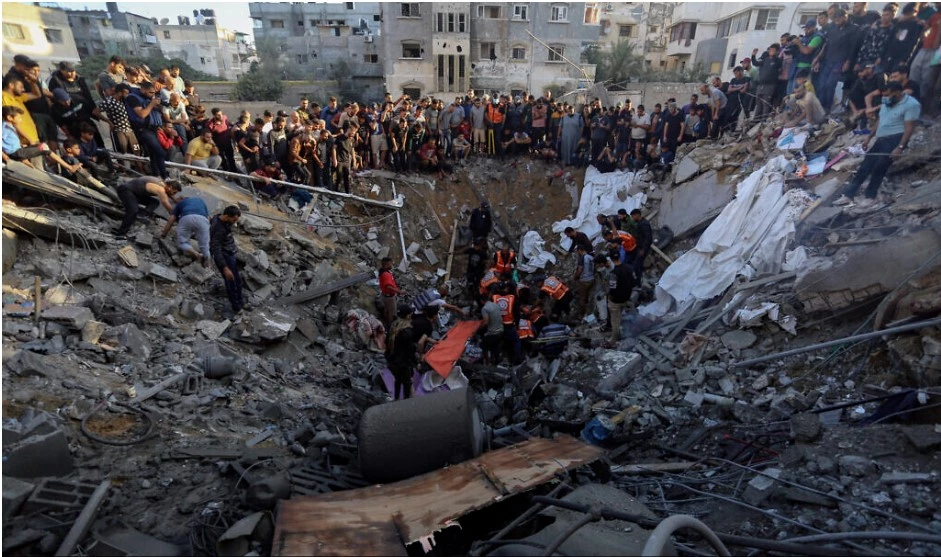

Overnight raids on the Gaza Strip killed at least 55 people, the Hamas government said on Sunday, after Israel announced it was stepping up strikes.
"More than 55 martyrs," the government press office said in a statement on the latest night of bombing in response to the Hamas attacks on Israel on October 7.
It added that more than 30 homes had been destroyed in the hours after an Israeli military spokesman said that raids would be increased.
The Hamas government says more than 4,300 people, mostly civilians, have been killed in Israeli raids since the war started in response to the worst attacks suffered by Israel with 1,400 dead, also mainly civilians.
Israel has massed tens of thousands of troops around Gaza for a widely predicted ground invasion. It says its daily raids have already killed many Hamas leaders and military commanders.
The Hamas government also hit out at the lack of aid arriving, despite the arrival of 20 trucks in the Palestinian territory on Saturday. It said there were now 1.4 million displaced people in the enclave.
"The aid that arrived in Gaza is not enough for one day. We call on the international community to pressure the Israeli government to bring in thousands of trucks," said the statement.
Israel vows to step up Gaza strikes before ground invasion
Israel's military said Saturday it would intensify strikes on Hamas-controlled Gaza ahead of a planned ground invasion, as UN agencies warned of a "catastrophic" humanitarian situation in the blockaded territory.
A first trickle of aid entered the Palestinian enclave from Egypt on Saturday, but the 20 trucks permitted to cross have been described as a "drop in the ocean" given the needs of 2.4 million residents.
Over 40 percent of all housing has been damaged or destroyed, according to the UN citing local authorities, and Israel has halted the delivery of food, water, fuel and electricity.
Israel will now intensify its bombardment, to minimise the risks to its troops when they begin a ground invasion, military spokesman Admiral Daniel Hagari said.
"From today, we are increasing the strikes and minimising the danger," he said.
"We will increase the attacks and therefore I called on Gaza City residents to continue moving south for their safety."
Israel has warned more than one million residents of the northern part of Gaza to move south for their safety, and the UN says more than half the enclave's population is now internally displaced.
Bombardment has continued in southern parts of the Strip though, with Hamas authorities reporting nine killed in an airstrike in Khan Younis overnight.
Hundreds of thousands of civilians are believed to remain in and around Gaza City in the north, unwilling or unable to leave.
- Qatar negotiating for hostage releases -
Israeli troops have massed on the border with Gaza and commanders visited frontline units on Saturday to rally troops.
"We will enter Gaza," chief of staff Lieutenant General Herzi Halevi told one infantry brigade on a visit.
"Gaza is densely populated, the enemy is preparing a lot of things there -- but we are also preparing for them," Halevi said.
A ground invasion poses myriad challenges for Israeli troops, who are likely to be confronted by Hamas booby traps and tunnels in a densely packed urban environment.
The safety of over 200 hostages abducted by Hamas on October 7 and held in Gaza is another complicating factor.
Two American hostages were released on Friday evening, after mediation from Qatar, which said more could be freed "very soon."
"We are taking a path that will very soon lead to release of the hostages, especially civilians," Qatari foreign ministry spokesman Majed Al-Ansari told the German Welt am Sonntag newspaper Saturday.
"We are currently working on an agreement under which all civilian hostages will be initially released," he added.
After negotiations and US pressure, 20 trucks carrying food and medicine, but no fuel, crossed from Egypt into Gaza on Saturday.
The crossing closed afterwards, and UN officials warned much more was needed.
"Gaza was a desperate humanitarian situation before the most recent hostilities," five UN agencies said in a statement.
"It is now catastrophic. The world must do more."
- 'Something needs to be done' -
At a peace summit organised by Egypt, UN chief Antonio Guterres again pleaded for a humanitarian ceasefire "to end this godawful nightmare."
In a sign of international divisions however, the meeting was unable to agree any joint call, with Western officials demanding a clear condemnation of Hamas, and Arab attendees opting to issue their own statement criticising world leaders.
Inside Gaza, shellshocked residents said they were unsure where to go or how to protect their families.
"Even in my worst nightmares, I never thought this could be possible," said Rami Abu Wazna, staring at the destruction in central Gaza's Al-Zahra neighbourhood.
The scale of the bombing has left basic systems unable to function, with the UN reporting around 40 unidentified bodies were buried in a mass grave in Gaza City on Saturday because cold storage ran out before they could be identified.
Across the border in Israel's Kibbutz Beeri, where Hamas fighters killed 10 percent of the population, preparations were underway for funerals on Sunday.
Romy Gold, 70, said residents were still struggling to comprehend the horror of their experience.
"Around us whole families were shot or butchered or burned alive," he told AFP.
Like many, he feels the ground invasion of Gaza "cannot come fast enough. Something needs to be done."
"We need some kind of assurance that it will not happen again," he said.
- 'Better to leave now' -
The conflict has sparked fears of a wider conflagration, with Israeli raids and settler attacks killing dozens of Palestinians in the West Bank.
Israel's military said Sunday it targeted "terror operatives" with an airstrike on a mosque in the West Bank's Jenin, where it said a group of Hamas and Islamic Jihad fighters were planning fresh attacks.
One person was killed and three injured in the strike, the Palestinian news agency Wafa said, citing the local Red Crescent.
Exchanges of fire also continued across Israel's northern border with Lebanon, where the military has traded strikes with Hezbollah.
In south Lebanon, Hezbollah said four of its fighters were killed, along with a member of Palestinian Islamic Jihad.
Israeli authorities reported three soldiers wounded, one of them seriously, in Hezbollah anti-tank fire on the village of Baram, and two Thai farm workers were also wounded.
Western leaders have warned Hezbollah against intervening in the conflict, but the group's number two said it stood ready to step up involvement.
"Let's be clear, as events unfold, if something comes up that calls for greater intervention by us, we will do so," Naim Qassem said.
Israel has evacuated dozens of northern communities, and nearly 4,000 people in Lebanon have fled border areas for the southern city of Tyre.
"All my children are young. If the apocalypse comes, how will I get them all out in one go?" said Mustafa al-Sayyid, in a classroom stripped of desks and dotted with thin mattresses.
"So I thought, better to leave now."
Israeli strikes knock out Damascus, Aleppo airports: Syria state media
Israeli strikes on Sunday put out of service war-torn Syria's two main airports, state media reported citing a military source, with the transport ministry saying flights were re-routed to Latakia.
While Israeli strikes have repeatedly caused the grounding of flights at the government-controlled airports in the capital Damascus and the northern city of Aleppo, it is the second time simultaneous strikes have hit the facilities since this month's conflict between Israel and Hamas began.
"At around 5:25 am (0225 GMT), the Israeli enemy carried out... an air attack... targeting Damascus and Aleppo international airports, leading to the death of a civilian worker at Damascus airport and wounding another," the military source said in the statement carried by state news agency SANA.
"Material damage to the airports' runways put them out of service," the statement added. The transport ministry said flights were diverted to Latakia airport.
The military source said the "simultaneous" strikes came "from the direction of the Mediterranean west of Latakia and from the direction of the occupied Syrian Golan", according to the statement.
On October 12, simultaneous strikes knocked both Damascus and Aleppo airports out of service, Syria said at the time.
Last weekend, Israeli strikes targeted Aleppo airport, wounding five people, a war monitor reported, also putting it out of service, according to the authorities.
During more than a decade of war in Syria, Israel has launched hundreds of air strikes on its northern neighbour, primarily targeting Iran-backed forces and Lebanese Hezbollah fighters as well as Syrian army positions.
Israel rarely comments on individual strikes it carries out on Syria, but it has repeatedly said it will not allow its arch foe Iran, which supports President Bashar al-Assad's government, to expand its presence there.