
Conservatives win German vote as far-right makes record gains
Liberal leader who sparked German government's downfall resigns
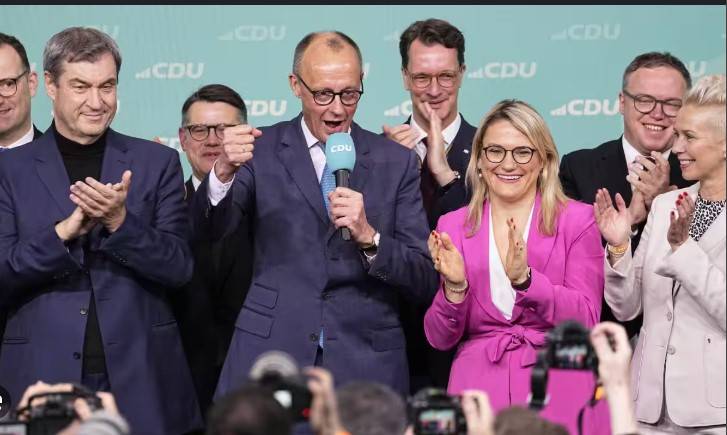

Germany's conservatives swept to victory in Sunday's elections, with their leader Friedrich Merz set to become the next chancellor, followed by the far-right AfD in second place after record gains.
Merz urged the speedy formation of a new coalition government, warning that as US President Donald Trump is driving rapid and disruptive changes, "the world isn't waiting for us".
He stressed that -- after Trump reached out to Russia and made comments fuelling doubts about the future strength of NATO -- Europe must boost its defence capabilities and said that he has "no illusions at all about what is coming out of America".
The far-right Alternative for Germany (AfD) almost doubled its score to over 20 percent, boosted by fears over immigration and security after a spate of deadly attacks blamed on asylum seekers.
Merz's CDU/CSU alliance won more than 28 percent, according to projections at 2000 GMT, crushing the Social Democrats (SPD) of outgoing Chancellor Olaf Scholz, which were looking at a historic low of 16 percent.
Merz -- a long-time party rival of ex-chancellor Angela Merkel -- has vowed a crackdown on irregular immigration. He hopes to win back votes from the AfD whose rise has stunned many in a country still seeking to atone for its dark Nazi history.
For now, the AfD, basking in the vocal support of key Trump allies, is set to stay in opposition. All other parties have vowed to keep it out of power and behind a "firewall" of non-cooperation.
But its jubilant leader Alice Weidel hailed the "historic" result and again said her party was ready to govern with the CDU/CSU.
"I am very afraid of this shift to the right," said retired teacher Hilke Reichersdorfer, 71, wearing a red scarf outside SPD headquarters. She voiced fears of a situation "like in other European countries or in America".
- 'Fate of Europe' -
Before Merz, 69, takes over, he will have to forge a new coalition government in Europe's top economy, an often drawn-out process he has vowed to complete by Easter.
This threatens to leave Berlin paralysed for weeks to come as Trump has forced head-spinning change and rattled European allies, especially over the Ukraine war.
The German election came amid tectonic upheaval in US-Europe ties sparked by Trump going over the heads of European leaders to make a direct outreach to Russian President Vladimir Putin to end the three-year-old Ukraine war.
"After Donald Trump's statements in the last week it is clear that the Americans are largely indifferent to the fate of Europe," Merz said in a post-election TV debate.
He said his "absolute priority will be to strengthen Europe as quickly as possible so that, step by step, we can really achieve independence from the USA" in defence matters.
To build a majority, Merz may first reach out to the SPD, though without Scholz, who apologised for his party's "bitter" defeat.
Merz could also approach the Greens, who scored 12 percent, although the CDU's Bavarian sister party the CSU has so far rejected this.
Another potential partner, the small FDP -- which sparked the November breakup of Scholz's government -- stared down the barrel of narrowly missing the five-percent hurdle to return to parliament.
This would impact the complex parliamentary arithmetic, as would the fate of the far-left BSW, which was just below the threshold late Sunday, at 4.9 percent.
If the BSW eventually scrapes in, this will mean Merz needs two coalition allies -- raising the spectre of yet another ideologically diverse alliance, like the failed alliance that was led by Scholz.
- 'Last chance' -
In a strange twist to the polarised campaign, the AfD has basked in the support of Team Trump, which saw billionaire Elon Musk praising it as the only party that can "save Germany".
Merz said "the interventions from Washington were no less dramatic and impertinent than the interventions we have seen from Moscow, so we are under massive pressure from two sides".
The AfD, strongest in the ex-communist east, also made gains in western states for its best-ever result after Germany was shocked by a series of deadly attacks blamed on migrants.
In December a car-ramming through a Christmas market crowd killed six people and wounded hundreds.
A stabbing spree targeting kindergarten children followed, then another car-ramming attack, in Munich, and a knife attack at Berlin's Holocaust memorial.
Merz has argued that the next government must boldly address the AfD's concerns on migration and also fix the ailing economy, warning that otherwise the far right might win next time around.
"The stakes could not be higher", argued political analyst and author Michael Broening.
"Germany's mainstream parties have consistently failed to convince voters to reject the far right, and this election could be their last chance to turn the tide."
Democratic forces must find solutions to the country's problems, he added. "If Germany's 'establishment' parties fail to deliver this time, they may not be the establishment for much longer".
Merz faces tough talks to build govt
Germany's conservative election winner Friedrich Merz vowed to get to work Monday on the arduous task of building a new coalition government, warning "the world isn't waiting for us".
Merz has warned against more paralysis in Berlin at a time US President Donald Trump is driving head-spinning change, the German economy is in recession, and society split after a polarising campaign.
Speaking late Sunday, his victory dampened by a far-right surge, Merz said a united Europe must build up its own defences as he had "no illusions at all about what is coming out of America".
With over 28 percent of the vote, his CDU/CSU bloc handily defeated Chancellor Olaf Scholz's Social Democrats (SPD) and the Greens, as the anti-immigration Alternative for Germany (AfD) celebrated a record of over 20 percent.
Following a heated campaign -- dominated by the flashpoint issue of immigration after a spate of deadly attacks blamed on migrants -- Merz will now have to reach out to his former campaign-trail SPD foes.
The conservatives will first enter talks without Scholz, who apologised for a "bitter" defeat at 16 percent, while his popular defence minister, Boris Pistorius, was expected to play a more central role.
In a TV debate late Sunday, Merz said he had been right to fight a "very tough election campaign" in which, on the eve of the vote, he had fumed about undefined "left-wing crazies".
"But now we will talk to each other," Merz said, striking a far more conciliatory tone. "We have to form a stable government as quickly as possible, with a good, stable majority."
- 'Herculean task' -
Merz must seek to establish communications with Trump, who has unsettled Ukraine and its European backers by reaching out to Russian President Vladimir Putin.
At the same time he must enter a process of horse-trading on party policies and red lines to hammer out a platform for a future governing alliance.
"These are difficult starting conditions for a new German government, which is facing Herculean tasks in domestic and foreign policy," said Cornelia Woll of the Hertie School Berlin.
"One might hope that Germany will nevertheless be able to act quickly, so that it does not just have to watch how Trump and Putin shape the future."
In an early positive response, Trump congratulated the conservatives on their win, describing it as "a great day for Germany, and for the United States".
"The people of Germany got tired of the no common sense agenda, especially on energy and immigration," said Trump, whose surrogates have hounded Scholz's outgoing administration.
French President Emmanuel Macron said he looked forward to jointly working with Merz for a "strong and sovereign Europe".
"In this period of uncertainty, we are united to face the great challenges of the world and of our continent," he posted on X.
Ukrainian President Volodymyr Zelensky also congratulated Merz, saying he looked forward to working with Germany to "strengthen Europe".
Liberal leader resigns
The head of Germany's pro-business Free Democrats (FDP), Christian Lindner, resigned Sunday after the party failed to cross the five-percent threshold to enter parliament.
Lindner, 46, served as finance minister in Olaf Scholz's unwieldy three-way coalition government but was often at odds with the Social Democrat chancellor.
Matters came to a head in November when Scholz fired him after a bitter falling out over government spending.
All but one of Lindner's FDP party colleagues resigned from the cabinet, paving the way for Sunday's early general election.
Early results showed the FDP heading for a disastrous result of around 4.4 percent -- seven percent down on the last election in 2021.
With the party's fate seemingly sealed, Lindner announced in a post on social media platform X that he would "retire from active politics".
"I have only one feeling: gratitude for 25 intense, challenging years full of productive work and debate."
Sunday's electoral collapse caps a turbulent political career for Lindner, who brought the party back from the wilderness and into government.
Lindner took the party reins in 2014 after it crashed out of the Bundestag. Under his leadership, the FDP doubled its vote share in 2017 and retook seats in parliament.
After the election, the liberal leader showed his early flair for the dramatic, walking out of talks with the Greens and the former chancellor Angela Merkel's conservatives.
"Better not to govern than to govern badly," he declared to waiting press.
Lindner got a second chance after the 2021 elections, securing his long-coveted role as finance minister in Scholz's government.
Ultimately, he could not bridge his ideological differences with his coalition partners from the Social Democrats and Greens.
Lindner, a die-hard fiscal hawk, baulked at Scholz's proposals to suspend Germany's constitutionally enshrined debt brake when it came back into force after the coronavirus pandemic -- leading to his exit from government.