
Araghchi says Iranians, not Trump, will elect new leader, Lebanon death toll hits 400, acid rain threat in Tehran
Israel military says struck Iran Guards 'space force' HQ, Hezbollah says it targeted northern Israel, including a naval base in Haifa and sending a swarm of drones towards the city of Nahariya
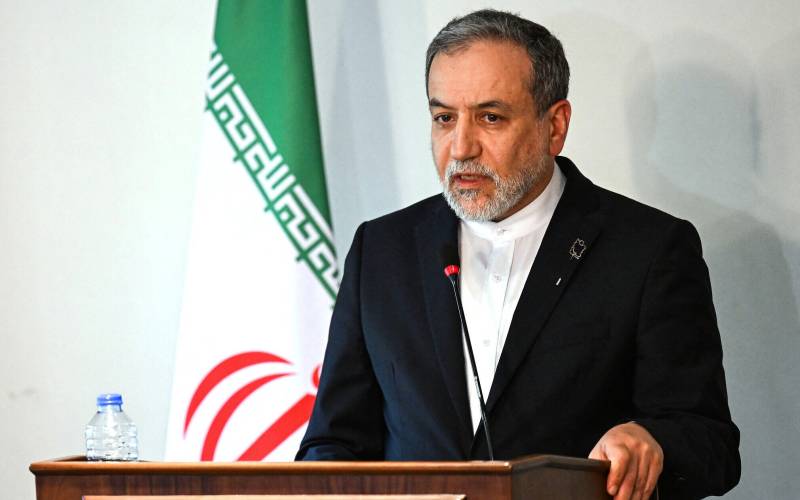

Iran's foreign minister said Sunday that the Iranian people, not Donald Trump, will elect their new leader and demanded that the US president apologise for starting the war with Iran.
"We allow nobody to interfere in our domestic affairs. This is up to the Iranian people to elect their new leader," Foreign Minister Abbas Araghchi told NBC's "Meet the Press."
Trump has asserted he should have a role in picking Iran's next supreme leader after Ali Khamenei died in the opening salvos of the US-Israeli attack that began nine days ago. He's also rejected the possibility of Khamenei's son, Mojtaba Khamenei, replacing his father.
Araghchi would not be drawn on who the successor would be. Iranian state media reported Sunday that the clerical body responsible for doing that had voted and that a name would be announced soon. Some clerics suggested Mojtaba would be chosen.
"We have to wait for the Assembly of Experts to convene and vote for the new supreme leader, and the one who is elected by them," he told NBC. Araghchi also said Trump "should apologize to people of the region and the Iranian people for the killings and destruction they have done against us."
He defended Iranian attacks that have hit Gulf neighbors during the war, saying those strikes were aimed at US bases in the region as Iranian missiles were unable to reach the United States.
"It is Americans who started this war against us, attacking us, and we are defending ourselves. So it is obvious that our missiles cannot reach the US soil," Araghchi said.
"What we can do is to attack American bases and American installations around us, which are unfortunately in the soil of our, you know, neighbor countries."
Trump has asserted that Iranian missiles could "soon" be able to strike the United States, although a US intelligence assessment as recently as 2025 stated Tehran did not have intercontinental ballistic missiles, and that it could take until 2035 for it to develop 60 such weapons.
Israel military says struck Iran Guards 'space force' HQ
The Israeli military said on Sunday it had struck what it described as the "space force headquarters" of Iran's Revolutionary Guards in Tehran.
"As part of the strikes, the IDF targeted and dismantled the Iranian terror regime's IRGC Space Force headquarters," the military said.
"The headquarters served as a reception, transmission and research centre for the Iranian Space Agency, which is affiliated with the regime's military," it said.
The military said the site included research facilities as well as the command-and-control centre for the "Khayyam" satellite, which was used to "monitor the State of Israel and its residents".
In August 2022, Russia launched the satellite on a Soyuz-2.1b rocket from Baikonur Cosmodrome in Kazakhstan.
Iran's space agency said at the time that the device was constructed by Russia under Iranian supervision.
The US said that the Khayyam satellite would give Iran "significant spying capabilities".
Iran's space agency rejected that, saying that the purpose of Khayyam was to "monitor the country's borders", and help with the management of natural resources and agriculture.
On Sunday, the Israeli military said it had also targeted other sites in Tehran, including around 50 bunkers that stored ammunition and a compound belonging to the Guards' ground forces.
Earlier, Israel struck a hotel in central Beirut on Sunday, the first attack on the city centre since the start of the new war with Hezbollah, as Lebanon said nearly 400 people were killed over the past week.
Lebanon was drawn into the Middle East war on Monday, when Iran-backed militant group Hezbollah attacked Israel in response to the killing of Iranian supreme leader Ayatollah Ali Khamenei during US-Israeli strikes.
Israel, which has kept up strikes targeting Hezbollah despite a 2024 ceasefire, launched multiple waves of strikes this week across Lebanon and sent ground troops into border areas.
Hezbollah said on Sunday that it repeatedly targeted northern Israel, including attacking a naval base in Haifa and sending a swarm of drones towards the city of Nahariya.
Israel's military, meanwhile, said that two of its soldiers were killed in combat in southern Lebanon, the first of its troops to have died since the latest offensive began on March 2.
It also reiterated its call for Lebanese residents to leave the area south of the Litani River, which covers many hundreds of square kilometres (miles).
Lebanon's health minister Rakan Nassereddine on Sunday said that Israeli strikes on Lebanon killed 394 people over the past week, including 83 children and 42 women.
Earlier the same day, the health ministry said an Israeli air strike hit Beirut's city centre, targeting "a hotel room" and killing four people and wounding 10 others.
- 'No safe place' -
"I came here from the southern suburbs to be safe with my children and the strike hit," said Abu Hussein, a 45-year-old taxi driver while showing his damaged car.
"There is no safe place." The strike was the first since Monday to target central Beirut.
An AFP photographer at the bombarded seafront hotel saw one room on the fourth floor with shattered glass and charred walls, while security forces cordoned off the site.
Israel's military said it had "conducted a precise strike targeting key commanders" in the Iranian Revolutionary Guards' Quds Force, its foreign operations arm.
A security official at the scene told AFP on condition of anonymity that Hezbollah-linked rescuers recovered three bodies from the hotel.
The area of Raouche is a major tourist destination and remained untouched by Israeli strikes during the previous war between Israel and Hezbollah, which ended with a ceasefire in November 2024.
Along its Mediterranean coast, the area is home to dozens of hotels, now overcrowded with displaced people who fled their homes elsewhere in Lebanon.
- Iranians evacuated -
Lebanon's government on Thursday banned any activity by the Iranian Revolutionary Guard Corps -- a main backer of the Lebanese militant group Hezbollah.
A Lebanese official who requested anonymity told AFP that "a total of 117 Iranians, including diplomats and embassy staff, were evacuated on a Russian plane that left Beirut overnight from Saturday to Sunday" for Turkey.
In the south, a strike on Sir al-Gharbiyeh, right above the Litani, killed 11 people including children according to the health ministry, with rescue efforts ongoing to find people under the rubble.
Standing next to a destroyed home, resident Ali Youssef Taha told AFP that "a family was sleeping inside" before "Israeli warplanes bombed the building, resulting in a massacre".
Later on Sunday, Lebanon's state-run National News Agency reported two Israeli strikes on the Palestinian refugee camp of Ain al-Hilweh in the south.
Israel's army said, meanwhile, that it struck "over 600" Hezbollah targets and killed 200 members of the group in the past week.
Lebanon's health minister insisted that "these are civilians being targeted, not, as they claim, military personnel and military installations", adding that nine rescuers had been killed since the start of the latest war.
On Friday night, a failed Israeli commando operation to find the remains of airman Ron Arad, missing since 1986, killed 41 people in eastern Lebanon.
Earlier, Iran’s Red Crescent has warned of a potential risk of acid rain following an explosion at an oil depot in Tehran, raising concerns about public health and environmental safety in the capital, the 24NewsHD TV channel reported on Sunday.
In a statement issued after the incident, the humanitarian organisation said that large quantities of hydrocarbons, along with sulphur and nitrogen oxides, had been released into the atmosphere and surrounding clouds as a result of the blast.
According to the Red Crescent, the presence of these compounds in the air significantly increases the likelihood that rainfall in affected areas could become acidic.
Officials cautioned that exposure to such rainfall may pose health risks, particularly skin irritation and respiratory problems.
They warned that contact with chemically contaminated rainwater could trigger skin conditions, while inhalation of polluted air might affect the lungs.
The Red Crescent advised residents to take precautionary measures if they are caught in the rain. Citizens have been urged to wash exposed skin with cold water immediately after coming into contact with rain.
The organisation also recommended that anyone whose clothes become wet during rainfall should change them promptly and place the contaminated garments in a sealed bag to minimise further exposure.
Authorities continue to monitor the situation as concerns grow about the environmental impact of the explosion and the potential health hazards posed by chemical pollutants in the atmosphere.
Kuwait airport, Bahrain desalination unit struck as Iran presses Gulf attacks
Iran struck Gulf infrastructure Sunday, hitting fuel tanks at Kuwait's airport and a desalination plant in Bahrain, with at least four reported dead in the region as Tehran pressed its campaign there into a second week.
In Saudi Arabia, the civil defence said a "military projectile" killed two people -- an Indian and a Bangladeshi -- and injured 12 others after it fell in a residential area in Al-Kharj governorate south of Riyadh.
In Kuwait, two border guards were killed "while performing their national duty", the interior ministry said, without elaborating on the circumstances.
Gulf countries have borne much of Tehran's response after the US and Israel launched a massive air campaign against Iran, with 18 people, 10 of them civilians, killed in the Gulf states since the war began, according to an AFP tally.
Iran's President Masoud Pezeshkian warned Sunday that the Islamic republic "will be forced to respond" against its neighbours if their territory was used to attack it.
On Saturday, the president had apologised to neighbouring countries hosting US military bases for attacks on their land.
Gulf countries have said their territory has not been used in attacks against Iran, and before the war began they repeatedly said they would not allow such a move.
Saudi Arabia, the United Arab Emirates, Qatar and Kuwait all reported new attacks on Sunday.
Fuel tanks at Kuwait's international airport were targeted in a drone attack, the military said.
The official Kuwait News Agency said a fire at the airport was brought under control, reporting no "significant injuries".
The military called the drone attack "a direct targeting of vital infrastructure".
A separate statement said "some civilian facilities sustained material damage as a result of falling fragments and debris from interception operations".
- 'Drone threats' -
Kuwait's national oil company announced a "precautionary" cut to its crude production, as the country's military said Sunday that it had responded to several drone and missile attacks.
Authorities said Kuwait's main building for social security was targeted, causing material damage, and that it would not receive visitors there on Sunday.
Bahrain's interior ministry said Sunday that an Iranian drone attack damaged a water desalination plant, accusing Tehran of "randomly" targeting civilian infrastructure.
Iran's Revolutionary Guards Corps said on Saturday that it had struck the United States' Juffair base in Bahrain, adding it had been used to attack an Iranian desalination plant earlier in the day.
Bahrain's national communication office later said the Iranian attack on the desalination facility had no impact on water supplies or network capacity.
Falling missile debris also injured three people and damaged a university building in the Muharraq area, the interior ministry said in a separate statement.
Saudi Arabia's defence ministry said on Sunday that it intercepted 33 drones, adding there were no reports of damage or casualties from the attacks.
Among them was a drone aimed at Riyadh's diplomatic quarter, also thwarted with no material damage or civilian injuries, the ministry's spokesman said, adding the capital and surrounding areas were targeted by 26 drones.
One drone targeted the Shaybah oil field in the southeast of the country, according to the Saudi defence ministry.
- 'At the disposal of the enemy' -
The UAE said its air defences detected 17 ballistic missiles on Sunday -- destroying 16, while one fell into the sea -- and intercepted 113 of 117 drones detected, with four falling inside the country.
Despite the Iranian president's apology to the Gulf countries for earlier strikes, hours later its judiciary chief said strikes would continue on sites in Gulf countries that were "at the disposal of the enemy".
UAE President Mohammed bin Zayed Al Nahyan said in a rare televised address that the Emirates were in "a period of war" and "will emerge stronger" from it.
Dubai briefly closed its main airport -- the world's busiest for international traffic -- on Saturday after authorities said an unidentified object was intercepted nearby.
A witness told AFP of a loud explosion in the area followed by a cloud of smoke. Footage verified by AFP recorded the sound of a drone followed by a loud explosion and plumes of smoke close to an airport concourse.
The government said there had been "a minor incident resulting from the fall of debris after an interception", without directly mentioning the airport. It said there were no injuries.