
PTI stages protest on Parliament premises for Imran’s release
In National Assembly, Law Minister assures protection of Khatm-e-Nabuwwat laws in minority rights legislation
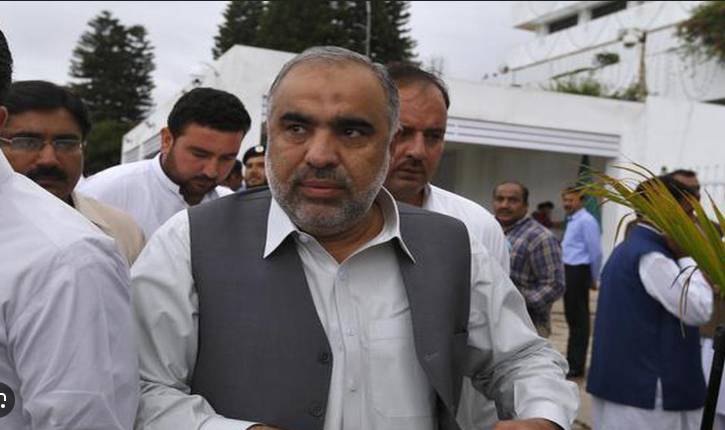

Pakistan Tehreek-e-Insaf (PTI) leaders and legislators on Tuesday staged a protest on the Parliament premises which was led by former National Assembly speaker Asad Qaiser, demanding release of party chairman Imran Khan.
According to 24NewsHD TV channel, the protest demonstration was attended by prominent PTI leaders, including Latif Khosa, Aamir Dogar, Ali Muhammad Khan, Atif Khan, and Shahid Khattak.
During the protest, party leaders raised slogans calling for the reinstatement of Zartaj Gul, Shibli Faraz, and Omar Ayub as PTI’s parliamentary leaders, and also chanted “Release Imran Khan” slogans.
In response to the gathering, a heavy police contingent was summoned to the Parliament precincts, while the Parliament's security personnel also remained on the site to ensure readiness in case of any untoward incident.
NA assured protection of Khatm-e-Nabuwwat laws
Federal Minister for Law and Justice Azam Nazeer Tarar assured the National Assembly that all laws pertaining to Khatm-e-Nabuwwat would remain fully safeguarded in any future legislation concerning minority rights, reaffirming the government’s unwavering commitment to preserving constitutional and religious principles while ensuring the protection of minority communities.
Responding to a concern raised by MNA Ali Muhammad Khan, the minister assured the legislators that the recently passed Minorities Rights Commission Bill would not impact the sanctity or enforcement of existing laws on Khatm-e-Nabuwwat, including the Anti-Qadianiat Ordinance of 1984.
The minister said that the bill had been examined clause by clause by a special Senate committee chaired by Senator Ali Zafar and comprising both legal experts and minority members. He stressed that the commission, once established, would have no criminal or prosecutorial powers and would only perform fact-finding and grievance redress functions relating to minority rights.
Tarar clarified that the overriding effect of the bill applied only within its limited mandate and did not override or dilute any existing provisions of laws related to the finality of Prophethood. He said the bill was fully in line with Article 20 of the Constitution, as interpreted by the Supreme Court, which upheld restrictions on Qadiani community members from propagating their beliefs.
Referring to landmark judgments, including the 1992 larger bench ruling and subsequent Supreme Court decisions, the minister said the judicial interpretations had firmly preserved the scope of relevant laws, leaving no room for any legal instrument to undermine them.
He reiterated that the government’s belief in and commitment to the finality of Prophethood was unwavering, and no legislation could be construed in a manner that would compromise it. “If there are still concerns, I am available to sit with all stakeholders, including religious scholars and parliamentary colleagues, to review the matter further,” he said.
Meanwhile, Tarar informed the House that the substantial hike in court fees for Supreme Court cases would be raised with the concerned authorities for due consideration.
Responding to a point of order raised by Sardar Latif Khosa in the National Assembly regarding the recent increase in Supreme Court fees, Tarar clarified that the determination or revision of court fees falls under the jurisdiction of the Supreme Court.
He explained that such matters are either decided by the full court or delegated to the Chief Justice. The recent revision, he noted, was undertaken after several decades and involved significant increases in certain categories.
The minister informed that in Punjab, representatives of bar associations had held meetings with the Chief Justice of the Lahore High Court and the provincial law minister, following which the fees had been rationalised to a reasonable level. He assured that similar steps would be considered in other jurisdictions where applicable.
Tarar stated that issues falling directly within the purview of his ministry would be addressed on a priority basis, while matters requiring legal procedures would be handled in accordance with the prescribed process. He reaffirmed the government’s commitment to supporting the legal community and ensuring fairness in judicial proceedings.
Railways Minister vows timely salaries
Minister for Railways Hanif Abbasi assured the National Assembly that the government was committed to resolving the pending payment of gratuity, benevolent fund, marriage grant and farewell grant to Pakistan Railways employees and their families at the earliest.
Responding to a calling attention notice moved by MNA Agha Rafiullah, he said routine pension payments were being made on time and salaries were now being disbursed before the 5th of every month, compared to past delays of up to two months. He added that overtime dues had also been cleared.
The minister said that benefits amounting to around Rs 12.5 billion were pending and the Ministry of Railways had already written to the Finance Division for the release of funds. “We have made strong efforts during the current budget process and will continue to push for the allocation so that these dues can be paid,” he said.
He informed the House that Pakistan Railways was the only federal department that managed its pension and employee benefits from its own accounts, whereas in other departments these payments came directly from the Finance Division. To address urgent needs, Rs 150 million had been earmarked from Railways’ own revenue for marriage and welfare grants, with plans to increase the amount as revenues improved.
Abbasi acknowledged that employees’ welfare was directly linked to the performance of the institution and reaffirmed that the government valued the contributions of the workforce, which kept Pakistan Railways operational.
Responding to a supplementary question from MNA Shazia Marri, the minister reiterated his resolve to use all available resources, including Railways’ own revenue streams, to address the pending benefits if federal funding was delayed. “It is my commitment that as our revenues grow, these payments will be prioritised,” he said.
16 private member bills introduced
As many as 16 private member bills were introduced in the National Assembly.
The bills were included the Islamabad Capital Territory Food Fortification Bill, 2025, the Criminal Laws (Amendment) Bill,2025) (Section 498D and Schedule Il), the Public Interest Disclosures (Amendment) Bill,2025, the Constitution (Amendment) Bill,2025 (Articles 1, 51, 59, 106, 154, 175A, 198 and 218), the Criminal Laws (Amendment) Bill,2025(Section 498D and Schedule II), the Elections (Amendment) Bill,2025, the Constitution (Amendment) Bill, 2025 (Articles 140A and 160A), the Guardians and Wards (Amendment) Bill,2025, the Legal Practitioners and Bar Councils (Amendment) Bill,2025, the Prevention of Obscenity and Indecency in Digital Media Bill, 2025, the Allied Institute, Multan Bill, 2025, the Service Tribunals (Amendment) Bill,2025,the National Database and Registration Authority (Amendment) Bill, 2025, the Islamabad Child and Adolescent Labour (Prohibition and Regulation) Bill,2025, the Multi-Vendor Electricity Distribution Bill, 2025 and the Toll Plaza Rationalization and Equity Bill,2025.
The bills were introduced by Shaista Pervaiz, Shazia Marri, Dr Sharmila Faruqui, Muhammad Riaz Fatyana, Sahibzada Sibghatullah, Awais Haider Jakhar, Nosheen Iftikhar, Shahida Rehmani, Khawaja Izhar ul Hassan, Sohail Sultan, Sehar Kamran, and Syed Abrar Ali Shah in the House.
The Chair referred all the bills to the concerned standing committees for detailed deliberation after not opposing them by the treasury benches.
Govt committed to minimizing flood losses
Minister for Parliamentary Affairs Dr Tariq Fazal Chaudhry said the National Disaster Management Authority (NDMA) was making all-out efforts to take preventive measures to minimize losses caused by floods and torrential rains across the country.
Responding to a matter of urgent public importance raised by Fatiullah in the National Assembly regarding the Prime Minister’s allocation of Rs 46 million for relief and rehabilitation in flood-hit Dera Ismail Khan, Minister for Parliamentary Affairs Dr Tariq Fazal Chaudhry said the government had subscribed to international disaster management applications (Apps) to enhance coordination and ensure timely transmission of alerts to provincial authorities.
The funds are intended to support victims and restore essential services following the region’s
Reporters Tayyab Saif and Rozina Ali