
Daily Covid tests double in Pakistan
NIH data shows a sharp plunge in infectivity rate: WHO warns Covid pandemic still volatile

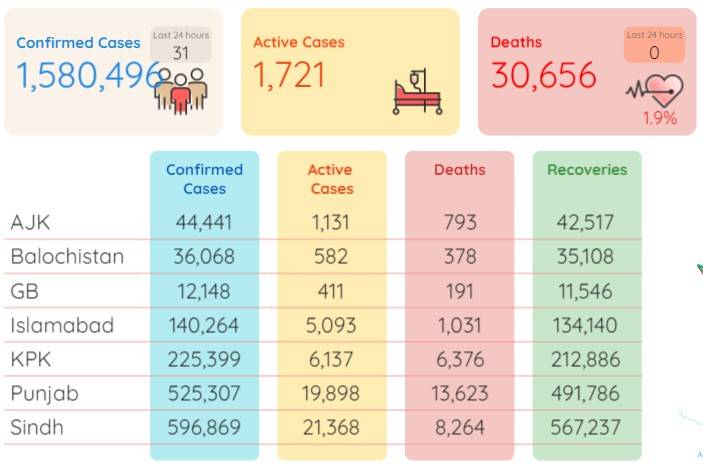
Daily number of tests doubled as Pakistan has taken in 31 more Covid-19 infections with no fatality during the last 24 hours (Tuesday), showed the data released by the National Institute of Health (NIH) on Wednesday morning, reported 24NewsHD TV channel.
According to the NIH data, the death toll in the country remained the same at 30,656 whereas the number of total infections now soared to 1,580,496 after adding the fresh 31 cases.
COVID-19 Statistics 19 April 2023
— NIH Pakistan (@NIH_Pakistan) April 18, 2023
Total Tests in Last 24 Hours: 3,793
Positive Cases: 31
Positivity %: 0.82%
Deaths: 00
Patients on Critical Care: 11
(shared by NCOC-NIH)
During the last 24 hours (Tuesday), 3,793 tests were conducted throughout Pakistan as compared to previous day’s over 1,700 whereas the positivity ratio stood at 0.82%. The number of patients in critical care stood at 11.
WHO warns Covid pandemic still volatile
The World Health Organization on Tuesday warned the Covid pandemic was still volatile, saying there could be further trouble before the virus settles into a predictable pattern.
In the last 28 days, more than 23,000 deaths and three million new cases have been reported to the WHO, in the context of much-reduced testing.
While the numbers are decreasing, "that's still a lot of people dying and that's still a lot of people getting sick", WHO emergencies director Michael Ryan told a press conference.
He said respiratory viruses do not pass from a pandemic to an endemic phase, but instead move to low levels of activity with potentially seasonal epidemic peaks.
"We don't turn off a pandemic switch," said Ryan.
"It's much more likely that we're going to see... a bumpy road to a more predictable pattern."
The WHO's emergency committee on Covid-19 meets every three months and is due to assemble in early May.
As at its previous meetings, it will decide whether the virus still constitutes a public health emergency of international concern (PHEIC) -- the highest level of alert that the UN health agency can sound.
The WHO declared Covid-19 a PHEIC on January 30, 2020, when there were fewer than 100 cases and no deaths outside China.
But it was not until WHO chief Tedros Adhanom Ghebreyesus described the situation as a pandemic in March 2020 that the world jolted into action.
Ryan said the virus would not be eliminated and would, like influenza, still cause significant respiratory disease in vulnerable people.
Some countries still have large populations of highly vulnerable people who are unvaccinated, he said, while in others Covid is no longer an emergency event.
The Covid-19 committee presents its advice to Tedros -- who has the final say -- on whether the virus still constitutes a PHEIC.
"I would hope that as the emergency committee meets in May, they will have further positive advice to give Dr Tedros around their assessment of the trajectory of the pandemic and the existence or not of a PHEIC," said Ryan.
With inputs from AFP.