
Eight Arab-Islamic states call for Gaza ceasefire, implementation of peace roadmap
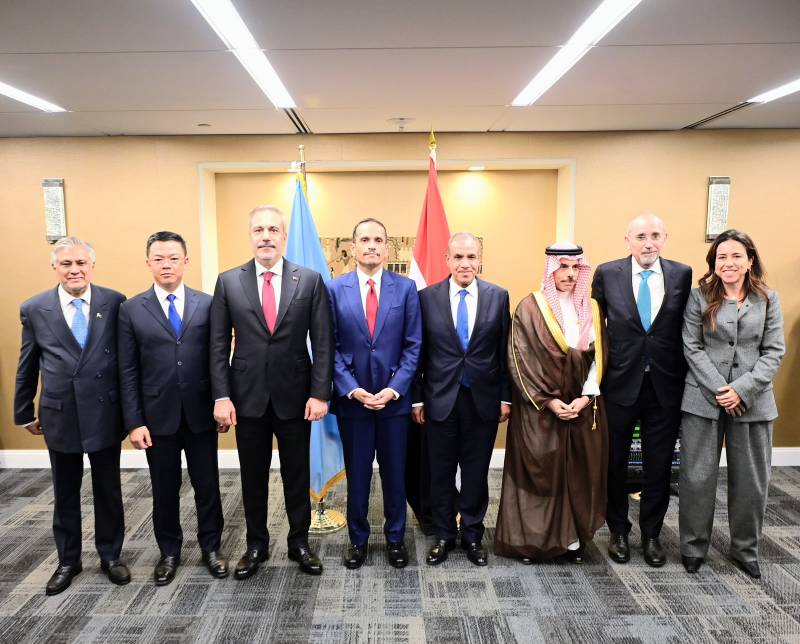

Foreign ministers of eight Arab and Islamic countries have expressed deep concern over the humanitarian situation in Gaza and called for maintaining the ceasefire, ensuring unhindered humanitarian assistance and implementing the roadmap for the next phase of the Gaza peace plan.
Foreign Office spokesperson Sajjad Haider Khan said the foreign ministers of Pakistan, Egypt, Qatar, Jordan, the United Arab Emirates, Indonesia, Türkiye and Saudi Arabia met in New York on Sept. 21 on the sidelines of the 81st session of the United Nations General Assembly and issued a joint statement following their meeting.
The same group of eight countries has coordinated repeatedly on Gaza and the implementation of the comprehensive peace plan, including through joint statements supporting a ceasefire, reconstruction and Palestinian self-determination.
In their latest statement, the ministers expressed deep concern over the continuing humanitarian suffering in Gaza and called on Israel to immediately fulfil its remaining obligations under the first phase of the comprehensive plan.
They said these obligations included ensuring the immediate, safe and unhindered delivery of humanitarian assistance and early recovery supplies, as well as facilitating the restoration of critical infrastructure.
The ministers stressed the need to preserve the ceasefire and end violations that could undermine the peace process.
They described the roadmap as an essential component of the comprehensive plan and said it provided the framework for moving towards its second phase.
According to the statement, the second phase includes the phased elimination of weaponry and armed capabilities, a complete withdrawal of Israeli forces, deployment of an International Stabilization Force and the assumption of responsibilities across Gaza by the National Committee for Gaza Administration.
The roadmap also envisages the start of early recovery and reconstruction efforts throughout Gaza. Elements including a phased Israeli withdrawal, the National Committee for Gaza Administration and an International Stabilization Force have also featured in earlier discussions on implementing the plan.
The foreign ministers urged all parties to fulfil their respective obligations in good faith and without delay.
They rejected any measures aimed at expelling Palestinians from their homeland or forcing their displacement and opposed attempts to change the territorial or demographic character of the occupied Palestinian territories.
The ministers also expressed concern over measures they said were aimed at consolidating Israeli control and annexation, including settlement expansion, land confiscation, demolition of Palestinian homes, settler violence and forced evictions.
They demanded the reversal of such measures and voiced concern over actions affecting the historical and legal status of Muslim and Christian holy sites in Jerusalem.
The eight countries have also previously jointly rejected proposals aimed at forcibly displacing Palestinians from Gaza and have called for preserving Palestinian rights under international law.
The ministers welcomed recent steps taken by the United Kingdom and broader national and European initiatives concerning Israeli settlements, including measures aimed at restricting trade linked to settlements.
They called for further measures to halt settlement expansion and ensure accountability for settler violence. Pakistan and the other seven countries had earlier welcomed Britain's decision to ban imports from Israeli settlements and European moves towards restrictions on settlement-linked trade.
The foreign ministers stressed that Gaza must remain an integral part of Palestinian territory and said implementation of the comprehensive plan should facilitate the reunification of Gaza with the West Bank, including East Jerusalem.
They said the process should provide a credible path towards the Palestinian people's right to self-determination and the establishment of a sovereign, viable and independent Palestinian state with East Jerusalem as its capital through implementation of the two-state solution.
The group has consistently backed a two-state solution and Palestinian statehood in previous joint statements on the Gaza plan.
The ministers also commended the leadership of US President Donald Trump and emphasised what they described as the indispensable role of the United States in ensuring implementation of the comprehensive plan.
They urged Washington to remain continuously and actively engaged to ensure that all parties, including Israel, fulfil their obligations and commitments and that obstacles to implementation of the roadmap are removed.
The foreign ministers said tangible progress on the ground would strengthen the credibility of the Board of Peace and the authority of the plan and help build momentum towards further progress.
They reiterated their commitment to continue working with the United States, the Board of Peace, the Palestinian Authority and other relevant parties for full implementation of the comprehensive plan and its roadmap.
The ministers said the objective was to alleviate the suffering of Palestinians, advance their right to self-determination and an independent state, and achieve a just, lasting and comprehensive peace in the region.