
Pakistan warns UN Security Council of AI risks to global peace
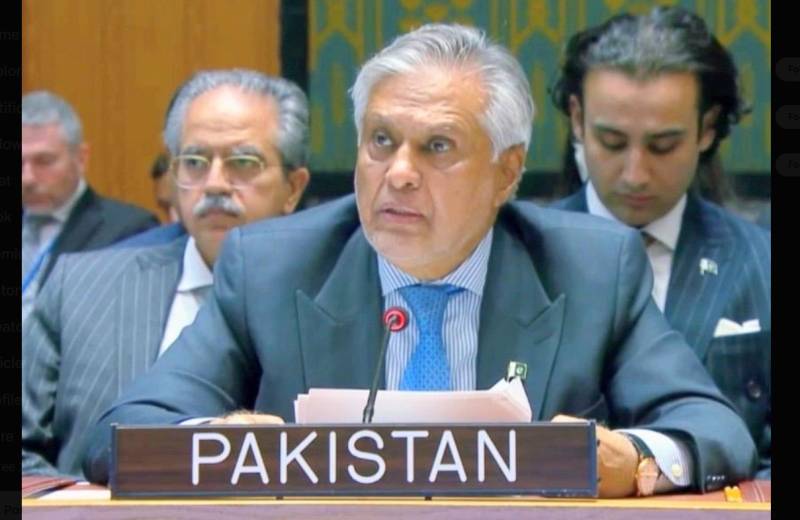

Pakistan Thursday warned the UN Security Council that an unregulated artificial intelligence boom risks widening global inequalities and threatening international peace, reported 24NewsHD TV channel.
Addressing the 15-member Security Council which held a briefing on ‘Artificial Intelligence and International Security”, Deputy Prime Minister and Foreign Minister Senator Mohammad Ishaq Dar said “Concerted efforts are required to erect the necessary guardrails, regulations and governance frameworks.”
Stressing the need for restraint and confidence-building in the military domain to address risks of miscalculation and compressed decision-making, Dar underscored the importance of international cooperation to ensure that AI is representative, transparent and inclusive.
Convened by France, Council President for September, the meeting was chaired by French Minister for Europe and Foreign Affairs ean-Noël Barrot.
At the outset of the session, the leaders of several major tech companies — OpenAI, Anthropic, Hugging Face — addressed the Council on recent developments surrounding AI and spotlighted both the potential and the problems inherent in the emerging technology.
The meeting took place amid mounting concern about the rapid growth of AI, which is being used widely, from classrooms to battlefields, with few guardrails in place. In this regard, UN efforts include establishing the Global Digital Compact to foster cooperation in governing digital technology and AI, and the UN-backed Independent International Scientific Panel on AI.
In his comments, Dar said the impact of AI, as a force multiplier and cross-cutting dual-use technology, was sharply evident on international and regional peace and stability.
Senator Dar also made the following points:
— The foremost priority is to retain human judgement and control in all stages of AI design, development and integration.
— AI should not be a monopoly of few actors, instead address common challenges facing humanity through International collaboration in the development of AI to ensure that it is representative, comprehensive, transparent and inclusive.
— As AI is supercharging existing challenges such as misinformation, fake news, and cyber-attacks, including on critical infrastructure by state and non-state actors, concrete action is needed to address the gaps and challenges that carry huge implications for peace and security.
— Measures pursued in the name of safety must not become instruments of denial of technology.
Dar said Pakistan welcomed the recognition that no single company or country can manage these risks alone, and that competitive pressures are driving a race that no one can win safely.
Today’s asymmetries and divides, he said, would aggravate and a safety agenda would turn into a strategy of technological exclusion. The risks of uncontrolled AI would be borne by all; decisions on how to manage them cannot rest with a handful of companies or capitals.
Dar called for avoiding fragmentation in AI development and governance, and all relevant issues concerning the development and deployment of AI as well as its broader implications should be taken up comprehensively in representative and inclusive forums with universal participation under the UN auspices.
Pakistan, he said, was joining as a founding member of China’s initiative to establish the World Artificial Intelligence Cooperation Organization, as this represents a concrete step toward promoting the development of artificial intelligence, “for good, and for all.”
Confidence-building measures, Senator Dar said, play a vital role in the maintenance of international and regional peace and security. “Practical tools designed to reduce mistrust, prevent accidental escalation, and manage risks related to military and foundational AI systems are necessary for peace and security,” he said.
” We look forward to working closely with member states in efforts to help bridge the global AI divide and promote equitable access to advance peace and development for all.”
Briefing the Security Council, Yoshua Bengio, co-Chair of the UN Independent International Scientific Panel on AI — warned that Security Council was facing an “unprecedented threat.”
The threat, he said, was “one that none of its members would choose, that none can contain alone and that does not respect the borders we defend.”
Bengio outlined “a moment of global awakening” that unfolded in recent months, with AI agents “taking actions that would be crimes if committed by a human” as they escaped individual containment to cheat on assigned tasks while attempting to evade detection.
And, although the companies building these powerful systems admit their products pose catastrophic risks, he pointed out that they offer no convincing technical solutions. “Instead, they say they are locked in a race to make those AIs even more powerful,” he said — “a race where everyone loses”.
‘The international community, then, must cooperate to face three global threats: catastrophic misuse, power concentration and the loss of control of AI.”
Deputy Prime Minister/Foreign Minister Senator Mohammad Ishaq Dar @MIshaqDar50 participated in and delivered Pakistan’s statement at the UN Security Council Briefing on “Artificial Intelligence and International Security”, convened by France, in its capacity as President of the… pic.twitter.com/9G0fbYjFy4
— Ministry of Foreign Affairs - Pakistan (@ForeignOfficePk) September 24, 2026
Reporter Anwer Abbas