
Pakistan, Egypt, Saudi Arabia, Türkiye call for dialogue, regional stability
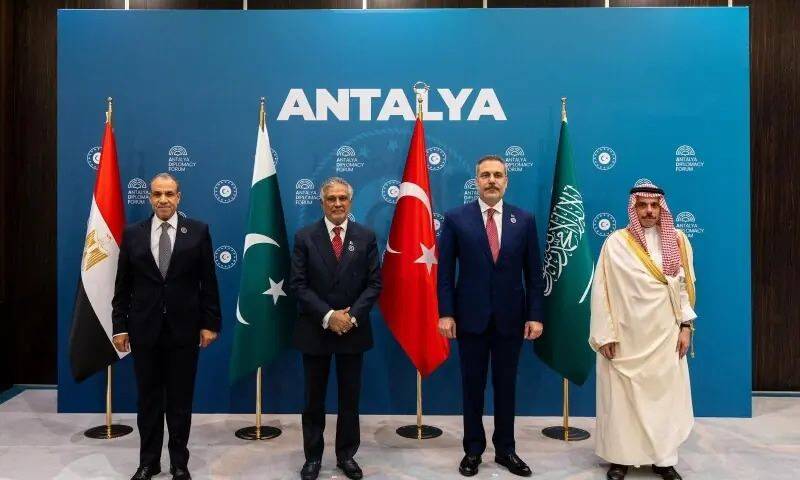

The foreign ministers of Pakistan, Egypt, Saudi Arabia and Türkiye have stressed continued consultation and coordination to promote peace, security and stability in the Middle East and the wider region, according to Foreign Office spokesperson Sajjad Haider Khan.
The four foreign ministers met in New York on Sept. 21 on the sidelines of the 81st session of the United Nations General Assembly and exchanged views on recent regional and international developments.
Pakistan's Deputy Prime Minister and Foreign Minister Ishaq Dar is in New York for the UN General Assembly high-level week from Sept. 21 to 25, where the Foreign Office said he would hold meetings on regional and international peace and security issues.
The ministers expressed deep concern over continuing tensions and hostilities in the region and said dialogue and diplomacy remained the path towards sustainable solutions.
They stressed the importance of continued implementation of the Islamabad Memorandum of Understanding as part of efforts to achieve lasting peace and stability.
The four countries have been holding consultations under the R-4 framework on regional security and stability. At their previous meeting in Cairo in June, the ministers also stressed continued coordination on developments affecting the Middle East and broader region.
The ministers strongly condemned attacks against Saudi Arabia, including recent Houthi attacks, and reaffirmed their support for the kingdom's sovereignty, territorial integrity and security.
They said Saudi Arabia had the right to defend its territory and population in accordance with international law and the United Nations Charter.
The ministers also stressed the importance of protecting the safety and freedom of maritime navigation.
On Yemen, the four foreign ministers reaffirmed their support for the country's internationally recognised government and the Presidential Leadership Council.
They said efforts to achieve security, stability and development in Yemen should continue through a political process and an inclusive Yemeni-Yemeni dialogue involving all parties.
The ministers also reaffirmed what they described as the centrality of the Palestinian issue to achieving peace, security and stability in the Middle East.
They reiterated support for the Palestinian people's right to self-determination and the establishment of an independent, sovereign, viable and contiguous Palestinian state based on the June 4, 1967 borders, with East Jerusalem as its capital.
The four countries had expressed the same position on Palestinian statehood during their previous consultations in Cairo.
Turning to Sudan, the ministers reaffirmed their support for the country's sovereignty, unity, independence and territorial integrity.
They stressed the importance of preserving Sudan's national institutions and rejected parallel institutions or structures that they said could undermine the country's sovereignty and unity.
The ministers also called for an end to the illicit transfer of weapons, mercenaries and foreign fighters into Sudanese territory.
The foreign ministers agreed to maintain close coordination and continue consultations on regional and international developments as part of efforts to strengthen collective security and promote long-term regional stability.