
Muhammad Mehdi delivers lecture at Johns Hopkins University on Asian and Pakistan security
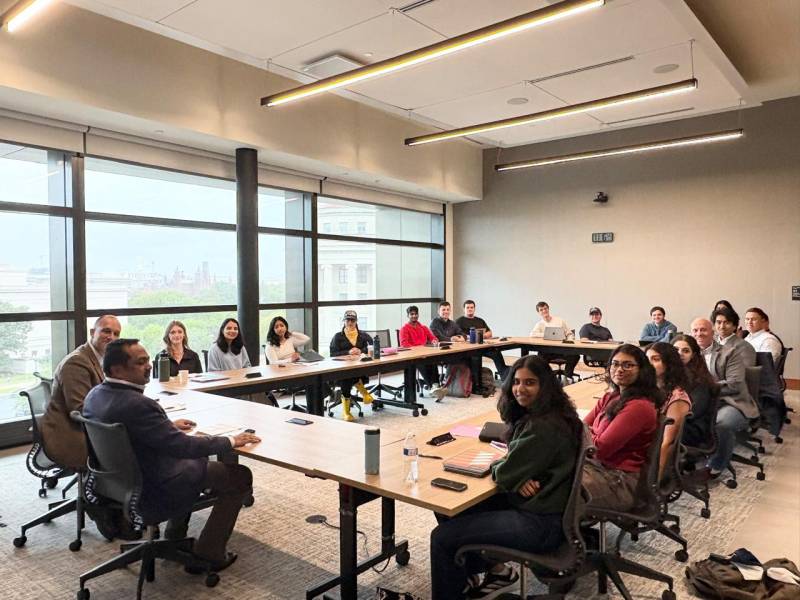

Renowned foreign affairs expert Muhammad Mehdi delivered a lecture at Johns Hopkins University in Washington, one of the world’s top 20 universities, on the current security situation in Asia and possible future scenarios. Following the lecture, he participated in a question-and-answer session with university faculty members and students.
In his address, Muhammad Mehdi said that viewing Pakistan’s national security solely through the lens of military power, defence capabilities, and border security presents only one part of the contemporary concept of state security.
According to him, in the modern international system, national security has become a multidimensional concept encompassing not only military defence but also economic stability, the effectiveness of political institutions, internal peace, cybersecurity, technological capacity, and public trust.
He said that political confrontation, institutional tensions, economic pressures, provincial grievances, and terrorism in Pakistan should not be viewed as separate issues, as these factors influence one another and collectively affect the overall capacity of the state. He maintained that sustainable national security requires strong institutions, the rule of law, economic stability, and public confidence in the state system.
Referring to Pakistan’s relations with China and the China-Pakistan Economic Corridor (CPEC), Muhammad Mehdi said that the success of major economic projects should be assessed not merely by infrastructure development but by their measurable economic outcomes. He identified industrial production, trade, exports, employment, and technology transfer as important indicators for evaluating the impact of such cooperation.
Regarding regional security, he stressed the need to assess various security arrangements, including the Mecca Defence Agreement, on the basis of treaty obligations and national interests. According to him, it is important to clearly understand the scope of collective defence, decision-making mechanisms, and Pakistan’s responsibilities in potential regional conflicts.
Discussing relations with the United States, he highlighted opportunities for cooperation in trade, investment, technology, and diplomacy. However, he noted that no external relationship can serve as a substitute for addressing Pakistan’s domestic economic weaknesses.
According to Muhammad Mehdi, Pakistan’s national security extends beyond defence capabilities to encompass the overall capacity of the state. Strong defence, a stable economy, effective institutions, academic and technological capacity, and public trust all play fundamental roles in ensuring national security.